Last updated: September 2026
If an HVAC technician tells you the compressor has failed, the price can be jarring. The compressor is one of the most expensive parts of a central air conditioner, and replacing it costs enough that many homeowners immediately wonder whether repairing the system still makes sense. This guide covers current costs, what drives the price, how warranties change the math, and how to decide between a compressor replacement and a new AC.
Quick Answer: How Much Does AC Compressor Replacement Cost?
- A common planning range for an out-of-warranty central AC compressor replacement is about $1,800 to $2,800 installed, averaging around $2,300 (HomeGuide). Larger or complex jobs can exceed $3,000.
- If the compressor is under warranty, you may still pay roughly $600 to $1,200 for labor, refrigerant, and related charges (Angi).
- Biggest cost drivers: system size, compressor type, brand, warranty status, refrigerant, labor, and whether another problem caused the failure.
- Before approving the repair, compare it against the age, condition, and replacement cost of the whole AC system.
What Does an AC Compressor Do?
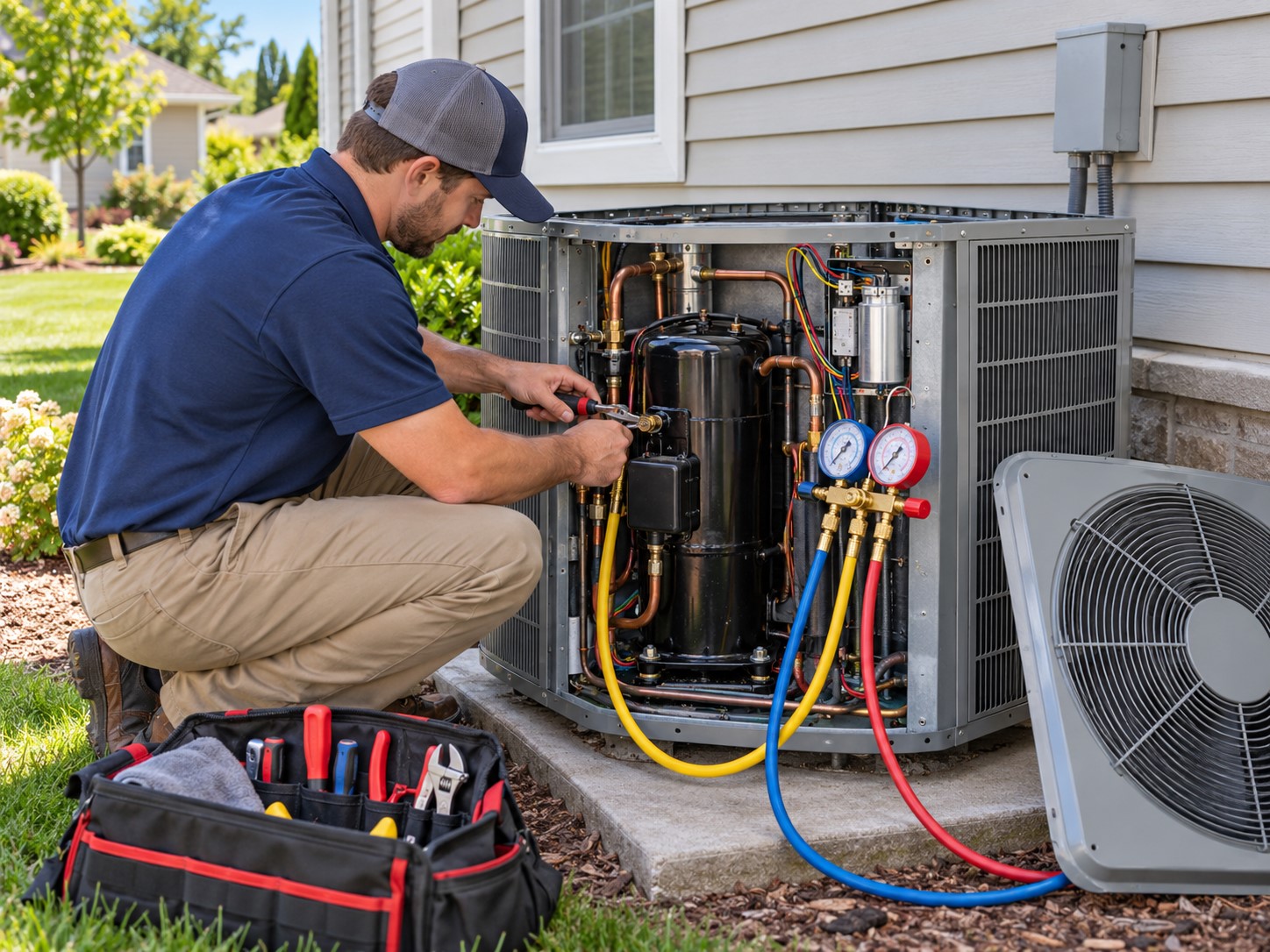
The compressor sits in the outdoor unit of a typical central air conditioner. It pressurizes and circulates refrigerant so the system can move heat from inside your home to the outdoors. If the compressor can’t run, the cooling cycle stops working and the system may blow warm air or shut down.

Because the compressor is a sealed mechanical component, a confirmed internal failure generally means replacing the compressor, not repairing its internal parts in the field.
How Much Does AC Compressor Replacement Cost?
National cost guides don’t all report the same number, which is why homeowners see conflicting figures online. HomeGuide places an installed compressor replacement at roughly $1,800 to $2,800, with an average near $2,300. Angi reports a lower professional installation range of about $800 to $2,300, and about $1,300 to $2,500 when the warranty has expired.
For planning, $1,800 to $2,800 is a useful benchmark for many out-of-warranty replacements, but it isn’t a quote. Warranty coverage, local labor rates, refrigerant work, system size, and the exact compressor can move a real estimate higher or lower.
Compressor Replacement Cost by AC Size
| AC System Size | Estimated Installed Cost |
|---|---|
| 1.5 tons | $1,500 – $2,000 |
| 2 – 2.5 tons | $1,800 – $2,200 |
| 3 – 3.5 tons | $2,000 – $2,600 |
| 4 – 4.5 tons | $2,200 – $2,800 |
| 5+ tons | $2,500 – $3,500+ |
Source: HomeGuide national cost data for out-of-warranty replacements, parts and labor. Local prices vary.
Why Warranty Coverage Matters So Much
Many manufacturers cover compressors for roughly 5 to 12 years, often with longer coverage if the equipment was registered after installation. If the compressor is still covered, you may avoid paying for the part itself. That doesn’t make the repair cheap, though.
You may still be responsible for labor, refrigerant recovery and recharge, diagnostic fees, shipping or processing fees, and other parts. Angi estimates about $600 to $1,200 when the compressor is under warranty. Most replacements take about 4 to 8 hours of certified technician time, according to HomeGuide.
Ask the contractor to separate the estimate into covered and non-covered items so you can see exactly what the warranty is saving you. If you’re not sure whether your equipment is registered, the manufacturer can usually look it up by serial number.
The Biggest Factors That Affect Compressor Replacement Cost
1. System Size and Compressor Capacity
Larger systems need larger compressors. A compressor for a 4- or 5-ton system typically costs more than one for a smaller system, and the refrigerant charge may be larger too.
2. Compressor Technology
Central air conditioners may use single-stage, two-stage, or variable-speed (inverter-driven) compressors. More advanced compressors and their matching electronics can cost considerably more than basic single-stage equipment.
3. Brand and Part Availability
Some compressors are widely available. Others are specific to one equipment line or need matched electronic controls. Availability, shipping, and manufacturer pricing all affect the estimate.
4. Refrigerant Work
Replacing a compressor requires professional handling of the refrigerant circuit: recovering refrigerant, replacing the compressor, evacuating the system, testing, and recharging. If the system was low on refrigerant because of a leak, that leak needs to be fixed too, not just topped off. Angi estimates additional refrigerant at roughly $100 to $350.
5. Labor and Access
An outdoor unit may be easy to reach or squeezed into a tight spot. Labor rates also vary by market and by whether the work is scheduled or an emergency call.
6. Other Damage in the System
A compressor failure isn’t always an isolated event. Depending on how it failed, the technician may recommend extra steps or parts, such as a new filter-drier, to protect the replacement compressor from contamination. Ask what caused the failure and what’s being done to protect the new compressor.
7. Older R-22 Systems
If your AC is old enough to use R-22 refrigerant (common in systems installed before about 2010), compressor replacement can cost far more. HomeGuide notes it can exceed $5,000 because R-22 is no longer produced in the U.S. In most cases, that makes full replacement worth a serious look.
Make Sure the Compressor Is Actually the Problem
An AC that won’t cool, or an outdoor unit that won’t start, doesn’t automatically have a failed compressor. A bad capacitor, contactor, thermostat, tripped breaker, electrical issue, low refrigerant, or safety control can cause similar symptoms. Carrier lists several of these as possible reasons a compressor won’t start. Many of those repairs cost far less than a new compressor.
Common signs that point toward a compressor problem include:
- The system runs but blows warm air
- The outdoor unit hums, clicks, or rattles but the fan or compressor won’t start
- The AC repeatedly trips the breaker
- Loud grinding, banging, or screeching from the outdoor unit
These are clues, not a diagnosis. A useful question to ask is: “What testing confirmed that the compressor itself has failed?” You don’t need to understand every electrical reading, but the contractor should explain the diagnosis clearly enough that you know why this repair is recommended. HomeGuide puts a professional AC inspection at roughly $150 to $500 if you want a second opinion.
What About R-410A and Newer Refrigerants?
Refrigerant rules changed for new residential AC equipment in 2025 and 2026, but that doesn’t mean an existing R-410A system must be replaced when its compressor fails. EPA guidance says existing systems can continue to be maintained and repaired throughout their useful life, including replacing a major component such as a compressor. R-410A parts can still be made and sold for servicing existing equipment.
So the practical question isn’t whether repairing R-410A equipment is allowed. It is. The better question is whether investing heavily in an older system makes financial sense given its age, condition, efficiency, and likely future repairs.
Get a Clear Picture Before You Pay
Our free Before You Hire Home Repair Cost Checklist helps you break down HVAC estimates, spot missing line items, and ask the right questions before you approve a major repair.
Replace the Compressor or Replace the AC?
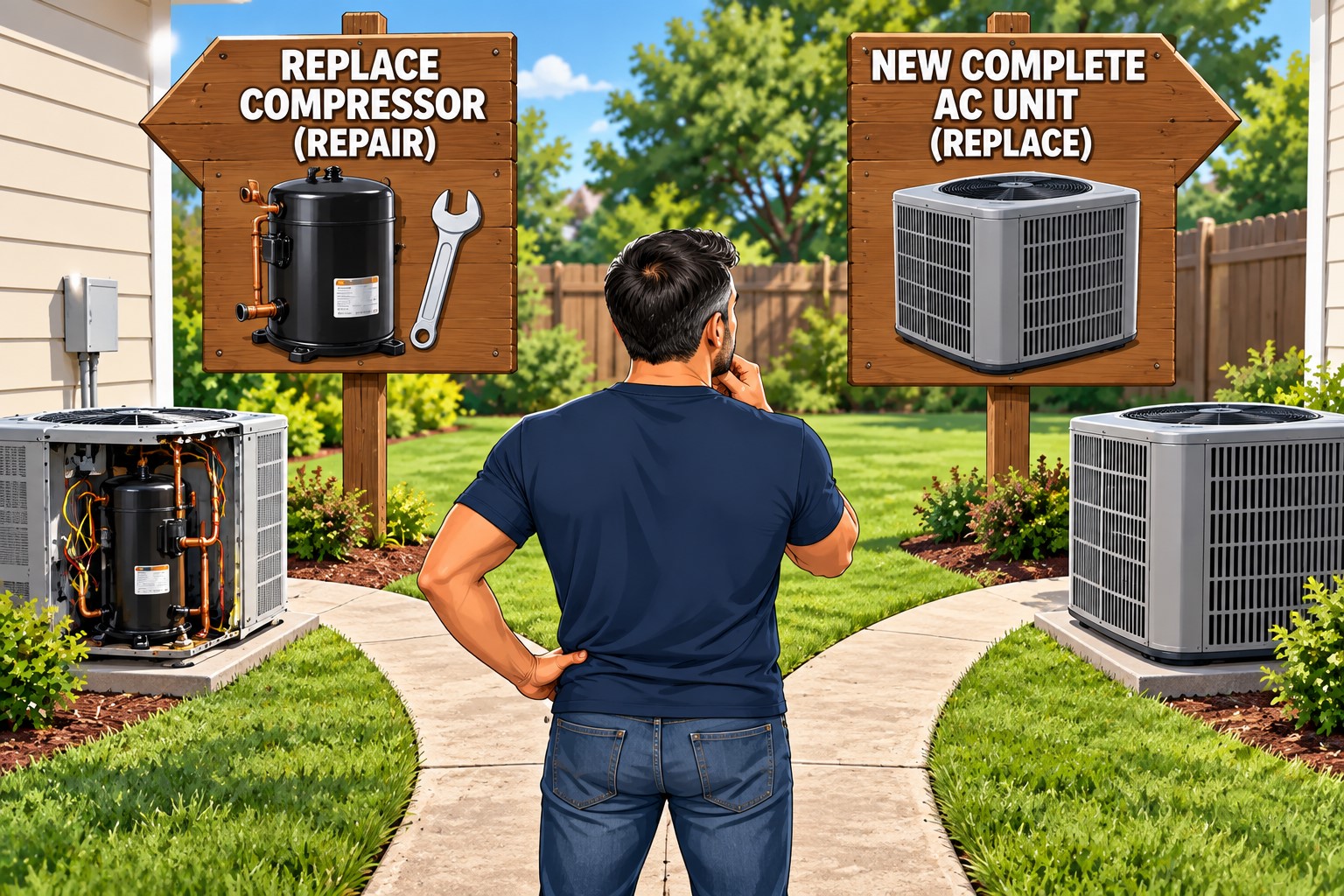
This is usually the most important decision in a compressor estimate.
Compressor replacement often makes sense when:
- The AC is relatively young (often under about 10 years old).
- The compressor is still under warranty.
- The rest of the system is in good condition.
- The repair restores a system that still has useful life left.
Full AC replacement deserves a closer look when:
- The compressor is out of warranty and the system is older.
- Other major components are wearing out, or the system has a history of expensive repairs.
- The system uses R-22 refrigerant.
- The compressor repair is a large share of the cost of a new system.
ENERGY STAR recommends having air conditioning equipment evaluated for replacement once it’s more than about 10 years old, especially when it needs frequent repairs, energy bills are rising, or the home isn’t staying comfortable. That’s a decision point, not an expiration date. For comparison, a full central AC replacement often runs about $5,000 to $12,500. See our full guide to AC replacement cost.
A Simple Example of the Decision
One homeowner has an 8-year-old AC with a compressor still under warranty. Their out-of-pocket cost is mostly labor and service charges, and the rest of the system is healthy. Repairing it may be an easy call.
Another homeowner has a 14-year-old unit, no warranty, a history of refrigerant leaks, and a $2,800 compressor estimate. Comparing that repair with a full replacement matters much more, because a new compressor doesn’t make the other 14-year-old parts new. The same failure can lead to two very different, reasonable decisions.
Questions to Ask Before Approving Compressor Replacement
- What testing confirmed that the compressor itself has failed?
- Is the compressor still covered by a manufacturer or extended warranty?
- How much of this estimate is parts, labor, refrigerant, and other charges?
- What caused the compressor to fail, if you can tell?
- Are there refrigerant leaks or other problems that also need fixing?
- What is the age and condition of the rest of my AC system?
- What refrigerant does my system use?
- What warranty applies to the new compressor and the labor?
- How does this repair cost compare with replacing the whole AC?
- If I replace only the compressor, do you expect other major parts to need attention soon?
Be Careful With “Compressor Repair” Shortcuts
Some lower-cost fixes can help a compressor start or correct a problem that was preventing it from running, such as replacing a failed capacitor or adding a hard-start component. Those can be legitimate, much cheaper repairs. But they aren’t the same as fixing a compressor that has failed mechanically, which is another reason to insist on a clear diagnosis before authorizing major work.
Don’t attempt compressor or refrigerant work yourself. EPA rules require Section 608 certification for work that opens the refrigerant circuit, and compressor replacement also involves high-voltage electrical work and specialized tools.
How to Compare Compressor Replacement Estimates
If you get more than one estimate, compare scope instead of just the bottom line. One contractor may include refrigerant, a new filter-drier, cleanup procedures, electrical parts, warranty paperwork, or follow-up testing that another lists separately or leaves out. Ask each contractor what could change the price once work begins. A clear written scope makes it easier to tell whether two estimates are truly comparable.
AC Compressor Replacement: Frequently Asked Questions
Is it worth replacing the compressor on a 10-year-old AC?
It can be, especially if the compressor is under warranty and the rest of the system is in good shape. If it’s out of warranty, uses R-22, or has other problems, get a replacement quote to compare before deciding.
How long does it take to replace an AC compressor?
Most compressor replacements take about 4 to 8 hours of technician time. Waiting for parts, especially brand-specific compressors, can add days.
Is the AC compressor covered by warranty?
Many manufacturers cover compressors for about 5 to 12 years, sometimes only if the equipment was registered. Warranties usually cover the part, not labor or refrigerant. Check your paperwork or ask the manufacturer.
Can an AC compressor be repaired instead of replaced?
A compressor that has failed internally generally has to be replaced. But the problem is sometimes a less expensive part, such as a capacitor or contactor, so confirm the diagnosis first.
Can I replace just the compressor instead of the whole outdoor unit?
Often, yes. Some homeowners compare replacing only the compressor with replacing the whole outdoor condensing unit or the entire system. Ask your contractor to price the options side by side so you can compare cost and expected lifespan.
The Bottom Line on AC Compressor Replacement Cost
For many homeowners, an out-of-warranty central AC compressor replacement costs roughly $1,800 to $2,800, and larger or more complex jobs can exceed $3,000. Warranty coverage can cut the part cost, but labor and related charges may still be significant.
Because the compressor is one of the most expensive parts of the system, the decision should look beyond the compressor alone. Confirm the diagnosis, check the warranty, understand what the estimate includes, and weigh the repair against the age and condition of the whole AC before spending thousands on one component.
Get the Free Before You Hire Checklist
Download our free Before You Hire Home Repair Cost Checklist. Use it to compare HVAC quotes, catch missing line items, and decide with confidence.
Sources
- HomeGuide: How Much Does an AC Compressor Cost?
- Angi: How Much Does an AC Compressor Cost? (2026 Data)
- Carrier: What Is an AC Compressor?
- U.S. EPA: Frequent Questions on the Phasedown of Hydrofluorocarbons
- U.S. EPA: Homeowners and Consumers FAQ
- ENERGY STAR: When Is It Time to Replace?
House Care
Compass provides general educational information to help homeowners better understand repair and replacement decisions.
Cost figures are national planning estimates and will vary by location, home, and contractor. For advice about your
specific home or project, consult an appropriately qualified professional.