AC Repair Cost: Common Repairs and What You May Pay
Last updated: September 2026
When a central air conditioner stops cooling, the repair bill can range from a small service call to a major part replacement that costs thousands. The useful question isn’t just “What does AC repair cost?” It’s: what failed, what does the repair include, is the part under warranty, and does repairing still make sense given the system’s age and condition?
Quick Answer: How Much Does AC Repair Cost?
- Many common repairs: about $150 to $650, with a national average around $350 to $360 (HomeGuide and Angi).
- Larger or complex repairs: about $650 to $2,500+, especially refrigerant leaks, coils, or compressors.
- Diagnostic/service call: typically $75 to $200, sometimes credited toward the repair.
- Biggest cost drivers: the failed part, labor time, warranty status, refrigerant work, access, emergency timing, and whether several parts are involved.
- These are planning ranges, not quotes. A technician has to diagnose the actual problem first.
What Does AC Repair Usually Cost?
HomeGuide puts many central AC repairs at about $150 to $650, with a national average of about $360, while Angi’s 2026 data shows an average near $350. Major repairs can reach $2,500 or more. The spread is large because “AC repair” covers everything from clearing a clogged drain line to replacing a compressor.
A diagnostic or service call commonly costs about $75 to $200 before any repair work. Some companies credit that fee toward the repair if you approve it; others bill it separately. HomeGuide puts technician labor at about $75 to $150 per hour. Emergency, weekend, and peak-season calls often cost more.
Common AC Repairs and Typical Costs

| Repair | Typical Cost | What It Does |
|---|---|---|
| Condensate drain line cleaning | $75 – $250 | Clears clogs that cause water leaks or shut the system off |
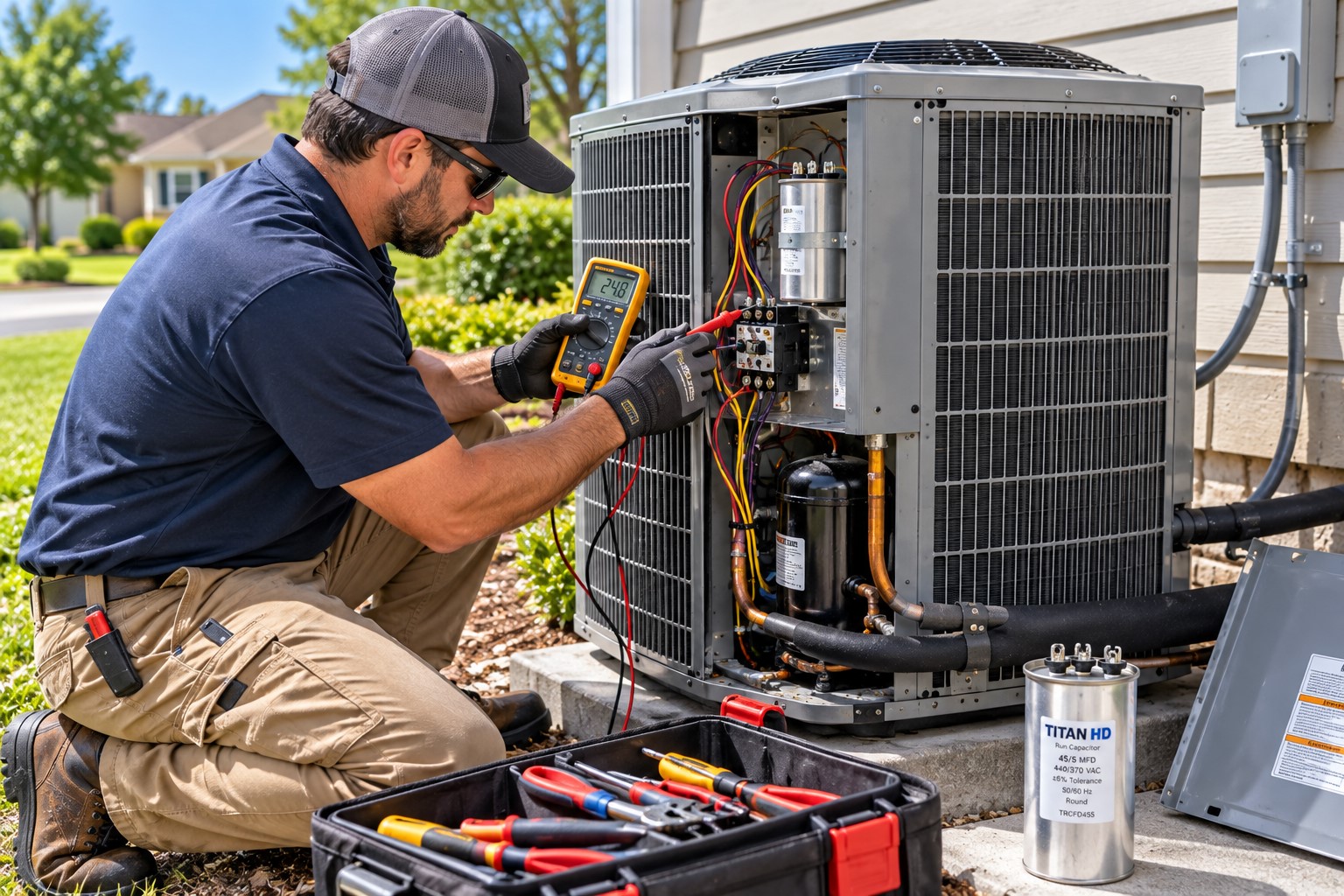
| Capacitor replacement | $100 – $250 | Helps motors start and run; a common cause of a humming outdoor unit |
| Refrigerant recharge | $100 – $600 | Restores refrigerant; should come with finding the leak |
| Thermostat replacement | $140 – $350 | A bad thermostat can mimic other AC problems |
| Control board replacement | $150 – $700 | Manages the system’s electrical functions |
| Contactor replacement | $200 – $450 | An electrical switch that lets the outdoor unit start |
| Condenser fan motor | $200 – $700 | Moves heat away from the outdoor unit |
| Refrigerant leak repair | $200 – $1,500 | Finds and fixes the source of lost refrigerant |
| Blower motor | $300 – $900+ | Moves cooled air through your ducts |
| Compressor replacement | $600 – $2,500+ | The heart of the system; one of the priciest repairs |
| Evaporator coil replacement | $1,000 – $4,500 | The indoor coil that absorbs heat from your home’s air |
Source: HomeGuide national cost data. Local prices vary. Compressor costs vary widely by guide and warranty status; out-of-warranty replacements often run about $1,800 to $2,800. See our AC compressor replacement cost guide for details.
Small electrical and drainage repairs usually land at the low end. Refrigerant leaks, blower motors, coils, and compressors push the bill much higher.
Quick, Safe Checks Before You Call
Some “AC problems” turn out to be simple settings or maintenance issues. Before scheduling a service call, it’s reasonable to check:
- Thermostat settings: set to “cool,” with the temperature below room temperature, and fresh batteries if it uses them.
- Air filter: a very dirty filter can restrict airflow and reduce cooling.
- Breaker: check whether the AC or furnace breaker has tripped. If it trips again after being reset once, leave it off and call a professional.
Safety note: Don’t open electrical panels on the AC unit or attempt refrigerant work
yourself. AC units carry high voltage, and refrigerant work requires EPA Section 608 certification.

Why One AC Repair Quote Can Be Much Higher Than Another
- The diagnosis is different. One technician may find a failed electrical part; another may find that the electrical failure was caused by a bigger motor or compressor problem.
- Warranty status. A manufacturer parts warranty can cut the cost of an expensive part, but labor, refrigerant, and diagnostic fees may still apply.
- Refrigerant work. Opening the sealed refrigerant system adds recovery, evacuation, leak testing, and recharging.
- Difficult access. Equipment in a tight attic, crawlspace, or rooftop takes more labor.
- Emergency timing. After-hours, weekend, holiday, and peak-season service often costs more.
- More than one repair. Ask whether each item is needed to restore cooling or is an optional recommendation.
Comparing AC Repair Quotes?
Our free Before You Hire Home Repair Cost Checklist helps you line up estimates side by side, spot missing line items, and ask the right questions before you approve a repair.
A Low Refrigerant Charge Isn’t Normal Maintenance
Homeowners are sometimes told the AC “just needs a little refrigerant.” That may restore cooling temporarily, but a central AC is a sealed system, and refrigerant doesn’t normally get used up. If the charge is low, there’s usually a leak.
Ask whether the technician found the leak, how it was diagnosed, and whether the quote includes repairing it rather than just adding refrigerant. Repeatedly recharging without fixing the cause can turn a smaller problem into an ongoing expense.
For existing R-410A systems, current EPA rules still allow you to maintain and repair your equipment throughout its useful life, including replacing major parts like a compressor, condensing unit, or indoor coil. The industry’s refrigerant transition doesn’t automatically mean your system has to be replaced. Older systems using R-22, however, can be expensive to recharge because that refrigerant is no longer produced in the U.S.
Does a Failed Part Mean You Need a New AC?
Not necessarily. A failed capacitor, contactor, thermostat, drain part, fan motor, or control board can be a reasonable repair on an otherwise dependable system. The decision gets harder when the repair involves a compressor, evaporator coil, repeated refrigerant leaks, or several major parts on an older system.
ENERGY STAR suggests considering replacement when an air conditioner is more than about 10 years old, especially if it needs frequent repairs, energy bills are rising, or comfort has declined. That doesn’t mean every 10-year-old AC should be replaced. It’s a reason to compare the repair cost with the system’s age, condition, efficiency, repair history, warranty status, and likely remaining life.
For comparison, many standard-to-midrange central AC replacements run about $5,000 to $12,500. See our guides to AC replacement cost and AC condenser replacement cost for full breakdowns.
Questions to Ask Before Approving an AC Repair
- What exactly failed, and how did you confirm it?
- Which part or parts are being replaced?
- Is the failed part covered by a manufacturer warranty?
- Does the estimate include labor, refrigerant, diagnostic fees, and materials?
- If the system is low on refrigerant, where is the leak, and is fixing it included?
- Will this restore normal operation, or are there other known problems?
- Are any items optional upgrades rather than required repairs?
- What warranty covers the repair labor and the new part?
- Given my system’s age and condition, would you repair it or compare replacement? Why?
- Could anything change the final price once the repair begins?
When a Second Opinion Is Worth It
- The repair estimate is in the high hundreds or thousands of dollars.
- You were told the compressor or evaporator coil has failed.
- The first recommendation jumps straight from a repair diagnosis to whole-system replacement.
- Two technicians gave you very different explanations for the same symptoms.
- The AC has had repeated major repairs in a short time.
- You’re being asked to replace several parts without a clear reason for each.
When comparing estimates, make sure both contractors are diagnosing the same failure and proposing the same repair. For major repairs, ask for the specific part or model being installed and whether it’s covered by a parts warranty. A lower quote isn’t automatically better if it doesn’t fix the cause.
AC Repair Cost: Frequently Asked Questions
What is the most common AC repair?
Capacitor replacements, clogged drain lines, and thermostat problems are among the most common, and they’re usually at the lower end of the cost range.
Is it worth repairing a 15-year-old AC?
It depends on the repair. A small, inexpensive fix may still make sense. A major repair like a compressor or coil on a 15-year-old system is worth comparing against a replacement quote, especially if it uses R-22 refrigerant.
Why is my AC running but not cooling?
Common causes include a dirty air filter, low refrigerant from a leak, a failed capacitor or fan motor, a frozen evaporator coil, or a compressor problem. A technician can diagnose the actual cause.
Does a home warranty cover AC repair?
Many home warranty plans cover some AC repairs, but coverage limits, exclusions, and service fees vary widely. Read your contract carefully and ask what’s covered before scheduling service.
The Bottom Line on AC Repair Cost
For planning, many central AC repairs cost about $150 to $650, while larger or more complex repairs can run $650 to $2,500 or more. Small electrical and drainage repairs usually land at the low end; refrigerant leaks, blower motors, coils, and compressors push the bill higher.
Before approving a large repair, make sure you understand what failed, whether the part is under warranty, what the estimate includes, and whether the repair makes financial sense for your system’s age and condition. The goal isn’t to pick the cheapest number. It’s to understand what you’re paying to fix and what that repair will accomplish.
Get the Free Before You Hire Checklist
Download our free Before You Hire Home Repair Cost Checklist. Use it to compare HVAC quotes, catch missing line items, and decide with confidence.
Sources
- HomeGuide: AC Repair Cost
- HomeGuide: HVAC Repair, Service, and Maintenance Cost
- HomeGuide: AC Refrigerant Leak Repair Cost
- Angi: HVAC Repair Cost (2026 Data)
- ENERGY STAR: When Is It Time to Replace?
- U.S. EPA: Frequent Questions on the Phasedown of HFCs
House Care
Compass provides general educational information to help homeowners better understand repair and replacement decisions.
Cost figures are national planning estimates and will vary by location, home, and contractor. For advice about your
specific home or project, consult an appropriately qualified professional.