
Hector | House Care Compass
AC Compressor Replacement Cost: Parts, Labor, and Your Options
Last updated: September 2026
If an HVAC technician tells you the compressor has failed, the price can be jarring. The compressor is one of the most expensive parts of a central air conditioner, and replacing it costs enough that many homeowners immediately wonder whether repairing the system still makes sense. This guide covers current costs, what drives the price, how warranties change the math, and how to decide between a compressor replacement and a new AC.
Quick Answer: How Much Does AC Compressor Replacement Cost?
- A common planning range for an out-of-warranty central AC compressor replacement is about $1,800 to $2,800 installed, averaging around $2,300 (HomeGuide). Larger or complex jobs can exceed $3,000.
- If the compressor is under warranty, you may still pay roughly $600 to $1,200 for labor, refrigerant, and related charges (Angi).
- Biggest cost drivers: system size, compressor type, brand, warranty status, refrigerant, labor, and whether another problem caused the failure.
- Before approving the repair, compare it against the age, condition, and replacement cost of the whole AC system.
What Does an AC Compressor Do?
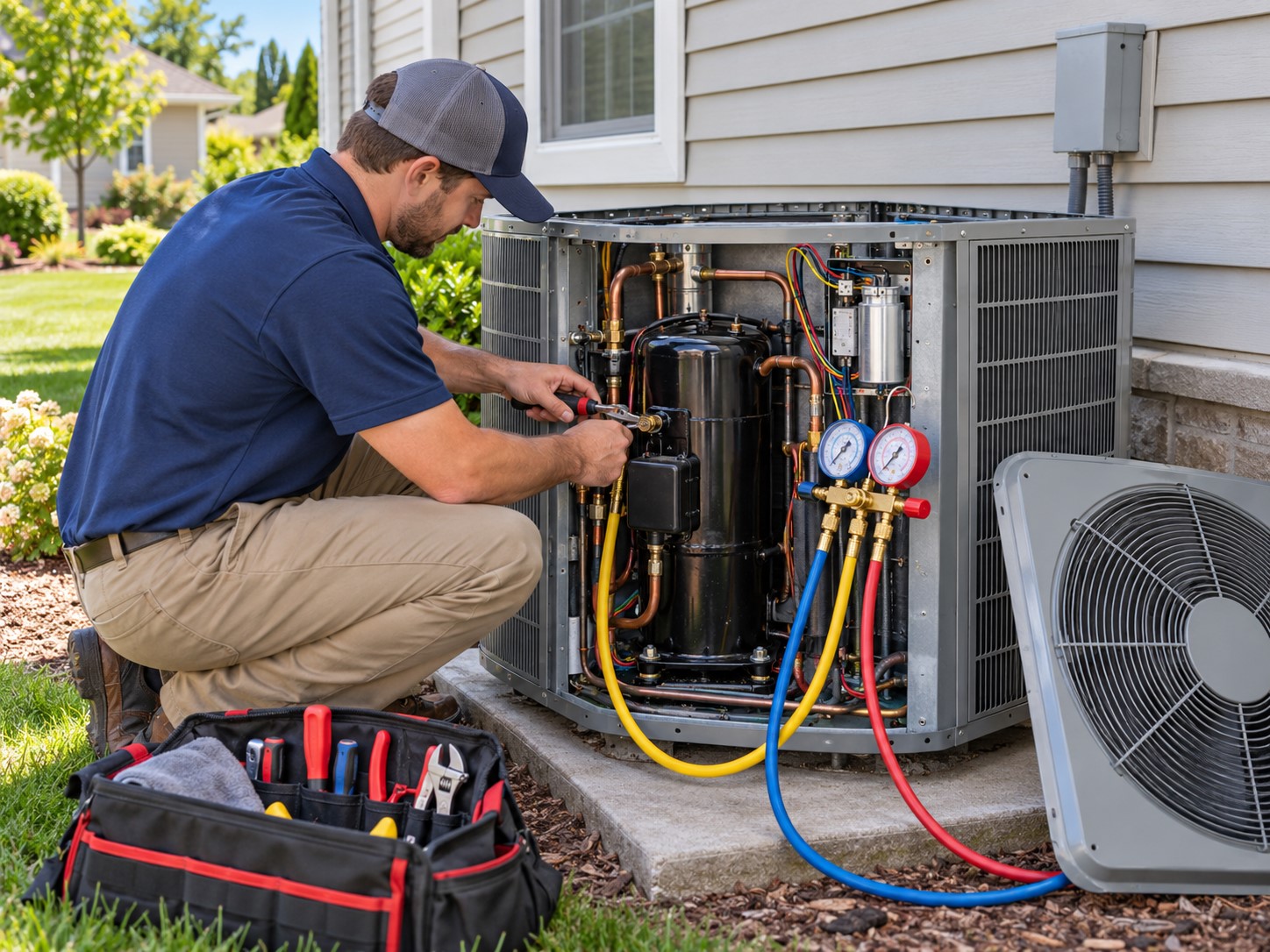
The compressor sits in the outdoor unit of a typical central air conditioner. It pressurizes and circulates refrigerant so the system can move heat from inside your home to the outdoors. If the compressor can’t run, the cooling cycle stops working and the system may blow warm air or shut down.

Because the compressor is a sealed mechanical component, a confirmed internal failure generally means replacing the compressor, not repairing its internal parts in the field.
How Much Does AC Compressor Replacement Cost?
National cost guides don’t all report the same number, which is why homeowners see conflicting figures online. HomeGuide places an installed compressor replacement at roughly $1,800 to $2,800, with an average near $2,300. Angi reports a lower professional installation range of about $800 to $2,300, and about $1,300 to $2,500 when the warranty has expired.
For planning, $1,800 to $2,800 is a useful benchmark for many out-of-warranty replacements, but it isn’t a quote. Warranty coverage, local labor rates, refrigerant work, system size, and the exact compressor can move a real estimate higher or lower.
Compressor Replacement Cost by AC Size
| AC System Size | Estimated Installed Cost |
|---|---|
| 1.5 tons | $1,500 – $2,000 |
| 2 – 2.5 tons | $1,800 – $2,200 |
| 3 – 3.5 tons | $2,000 – $2,600 |
| 4 – 4.5 tons | $2,200 – $2,800 |
| 5+ tons | $2,500 – $3,500+ |
Source: HomeGuide national cost data for out-of-warranty replacements, parts and labor. Local prices vary.
Why Warranty Coverage Matters So Much
Many manufacturers cover compressors for roughly 5 to 12 years, often with longer coverage if the equipment was registered after installation. If the compressor is still covered, you may avoid paying for the part itself. That doesn’t make the repair cheap, though.
You may still be responsible for labor, refrigerant recovery and recharge, diagnostic fees, shipping or processing fees, and other parts. Angi estimates about $600 to $1,200 when the compressor is under warranty. Most replacements take about 4 to 8 hours of certified technician time, according to HomeGuide.
Ask the contractor to separate the estimate into covered and non-covered items so you can see exactly what the warranty is saving you. If you’re not sure whether your equipment is registered, the manufacturer can usually look it up by serial number.
The Biggest Factors That Affect Compressor Replacement Cost
1. System Size and Compressor Capacity
Larger systems need larger compressors. A compressor for a 4- or 5-ton system typically costs more than one for a smaller system, and the refrigerant charge may be larger too.
2. Compressor Technology
Central air conditioners may use single-stage, two-stage, or variable-speed (inverter-driven) compressors. More advanced compressors and their matching electronics can cost considerably more than basic single-stage equipment.
3. Brand and Part Availability
Some compressors are widely available. Others are specific to one equipment line or need matched electronic controls. Availability, shipping, and manufacturer pricing all affect the estimate.
4. Refrigerant Work
Replacing a compressor requires professional handling of the refrigerant circuit: recovering refrigerant, replacing the compressor, evacuating the system, testing, and recharging. If the system was low on refrigerant because of a leak, that leak needs to be fixed too, not just topped off. Angi estimates additional refrigerant at roughly $100 to $350.
5. Labor and Access
An outdoor unit may be easy to reach or squeezed into a tight spot. Labor rates also vary by market and by whether the work is scheduled or an emergency call.
6. Other Damage in the System
A compressor failure isn’t always an isolated event. Depending on how it failed, the technician may recommend extra steps or parts, such as a new filter-drier, to protect the replacement compressor from contamination. Ask what caused the failure and what’s being done to protect the new compressor.
7. Older R-22 Systems
If your AC is old enough to use R-22 refrigerant (common in systems installed before about 2010), compressor replacement can cost far more. HomeGuide notes it can exceed $5,000 because R-22 is no longer produced in the U.S. In most cases, that makes full replacement worth a serious look.
Make Sure the Compressor Is Actually the Problem
An AC that won’t cool, or an outdoor unit that won’t start, doesn’t automatically have a failed compressor. A bad capacitor, contactor, thermostat, tripped breaker, electrical issue, low refrigerant, or safety control can cause similar symptoms. Carrier lists several of these as possible reasons a compressor won’t start. Many of those repairs cost far less than a new compressor.
Common signs that point toward a compressor problem include:
- The system runs but blows warm air
- The outdoor unit hums, clicks, or rattles but the fan or compressor won’t start
- The AC repeatedly trips the breaker
- Loud grinding, banging, or screeching from the outdoor unit
These are clues, not a diagnosis. A useful question to ask is: “What testing confirmed that the compressor itself has failed?” You don’t need to understand every electrical reading, but the contractor should explain the diagnosis clearly enough that you know why this repair is recommended. HomeGuide puts a professional AC inspection at roughly $150 to $500 if you want a second opinion.
What About R-410A and Newer Refrigerants?
Refrigerant rules changed for new residential AC equipment in 2025 and 2026, but that doesn’t mean an existing R-410A system must be replaced when its compressor fails. EPA guidance says existing systems can continue to be maintained and repaired throughout their useful life, including replacing a major component such as a compressor. R-410A parts can still be made and sold for servicing existing equipment.
So the practical question isn’t whether repairing R-410A equipment is allowed. It is. The better question is whether investing heavily in an older system makes financial sense given its age, condition, efficiency, and likely future repairs.
Get a Clear Picture Before You Pay
Our free Before You Hire Home Repair Cost Checklist helps you break down HVAC estimates, spot missing line items, and ask the right questions before you approve a major repair.
Replace the Compressor or Replace the AC?
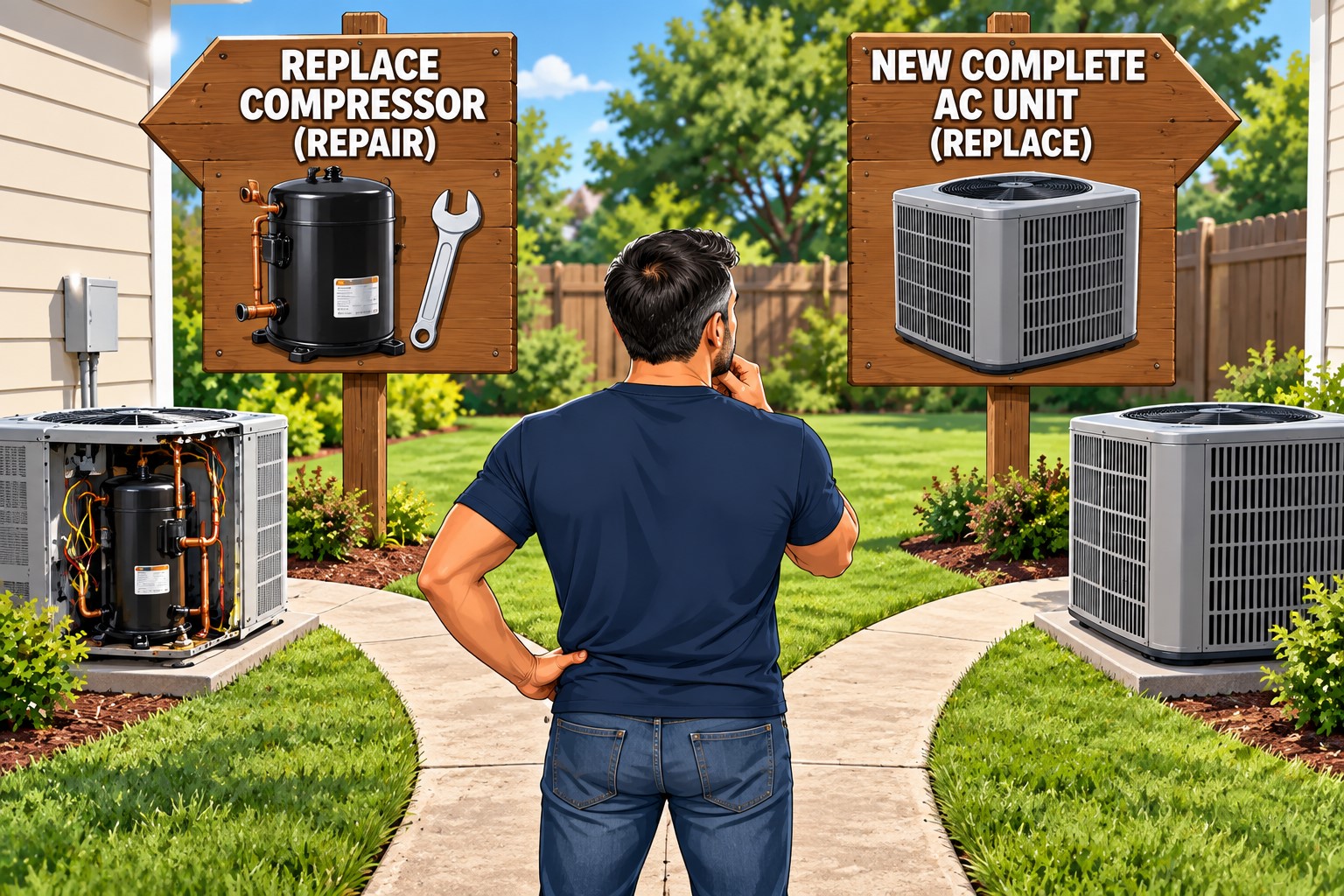
This is usually the most important decision in a compressor estimate.
Compressor replacement often makes sense when:
- The AC is relatively young (often under about 10 years old).
- The compressor is still under warranty.
- The rest of the system is in good condition.
- The repair restores a system that still has useful life left.
Full AC replacement deserves a closer look when:
- The compressor is out of warranty and the system is older.
- Other major components are wearing out, or the system has a history of expensive repairs.
- The system uses R-22 refrigerant.
- The compressor repair is a large share of the cost of a new system.
ENERGY STAR recommends having air conditioning equipment evaluated for replacement once it’s more than about 10 years old, especially when it needs frequent repairs, energy bills are rising, or the home isn’t staying comfortable. That’s a decision point, not an expiration date. For comparison, a full central AC replacement often runs about $5,000 to $12,500. See our full guide to AC replacement cost.
A Simple Example of the Decision
One homeowner has an 8-year-old AC with a compressor still under warranty. Their out-of-pocket cost is mostly labor and service charges, and the rest of the system is healthy. Repairing it may be an easy call.
Another homeowner has a 14-year-old unit, no warranty, a history of refrigerant leaks, and a $2,800 compressor estimate. Comparing that repair with a full replacement matters much more, because a new compressor doesn’t make the other 14-year-old parts new. The same failure can lead to two very different, reasonable decisions.
Questions to Ask Before Approving Compressor Replacement
- What testing confirmed that the compressor itself has failed?
- Is the compressor still covered by a manufacturer or extended warranty?
- How much of this estimate is parts, labor, refrigerant, and other charges?
- What caused the compressor to fail, if you can tell?
- Are there refrigerant leaks or other problems that also need fixing?
- What is the age and condition of the rest of my AC system?
- What refrigerant does my system use?
- What warranty applies to the new compressor and the labor?
- How does this repair cost compare with replacing the whole AC?
- If I replace only the compressor, do you expect other major parts to need attention soon?
Be Careful With “Compressor Repair” Shortcuts
Some lower-cost fixes can help a compressor start or correct a problem that was preventing it from running, such as replacing a failed capacitor or adding a hard-start component. Those can be legitimate, much cheaper repairs. But they aren’t the same as fixing a compressor that has failed mechanically, which is another reason to insist on a clear diagnosis before authorizing major work.
Don’t attempt compressor or refrigerant work yourself. EPA rules require Section 608 certification for work that opens the refrigerant circuit, and compressor replacement also involves high-voltage electrical work and specialized tools.
How to Compare Compressor Replacement Estimates
If you get more than one estimate, compare scope instead of just the bottom line. One contractor may include refrigerant, a new filter-drier, cleanup procedures, electrical parts, warranty paperwork, or follow-up testing that another lists separately or leaves out. Ask each contractor what could change the price once work begins. A clear written scope makes it easier to tell whether two estimates are truly comparable.
AC Compressor Replacement: Frequently Asked Questions
Is it worth replacing the compressor on a 10-year-old AC?
It can be, especially if the compressor is under warranty and the rest of the system is in good shape. If it’s out of warranty, uses R-22, or has other problems, get a replacement quote to compare before deciding.
How long does it take to replace an AC compressor?
Most compressor replacements take about 4 to 8 hours of technician time. Waiting for parts, especially brand-specific compressors, can add days.
Is the AC compressor covered by warranty?
Many manufacturers cover compressors for about 5 to 12 years, sometimes only if the equipment was registered. Warranties usually cover the part, not labor or refrigerant. Check your paperwork or ask the manufacturer.
Can an AC compressor be repaired instead of replaced?
A compressor that has failed internally generally has to be replaced. But the problem is sometimes a less expensive part, such as a capacitor or contactor, so confirm the diagnosis first.
Can I replace just the compressor instead of the whole outdoor unit?
Often, yes. Some homeowners compare replacing only the compressor with replacing the whole outdoor condensing unit or the entire system. Ask your contractor to price the options side by side so you can compare cost and expected lifespan.
The Bottom Line on AC Compressor Replacement Cost
For many homeowners, an out-of-warranty central AC compressor replacement costs roughly $1,800 to $2,800, and larger or more complex jobs can exceed $3,000. Warranty coverage can cut the part cost, but labor and related charges may still be significant.
Because the compressor is one of the most expensive parts of the system, the decision should look beyond the compressor alone. Confirm the diagnosis, check the warranty, understand what the estimate includes, and weigh the repair against the age and condition of the whole AC before spending thousands on one component.
Get the Free Before You Hire Checklist
Download our free Before You Hire Home Repair Cost Checklist. Use it to compare HVAC quotes, catch missing line items, and decide with confidence.
Sources
- HomeGuide: How Much Does an AC Compressor Cost?
- Angi: How Much Does an AC Compressor Cost? (2026 Data)
- Carrier: What Is an AC Compressor?
- U.S. EPA: Frequent Questions on the Phasedown of Hydrofluorocarbons
- U.S. EPA: Homeowners and Consumers FAQ
- ENERGY STAR: When Is It Time to Replace?
House Care
Compass provides general educational information to help homeowners better understand repair and replacement decisions.
Cost figures are national planning estimates and will vary by location, home, and contractor. For advice about your
specific home or project, consult an appropriately qualified professional.
Roof Repair Cost: Common Repairs and What Affects the Price

Last updated: September 2026
A roof problem can range from a few missing shingles to hidden water damage, so no single price fits every repair. This guide covers current planning ranges for common roof repairs, what makes a repair more expensive, and what to ask before you approve the work.
Quick Answer: How Much Does Roof Repair Cost?
- Many asphalt shingle roof repairs fall around $350 to $1,500, with a national average near $800 (HomeGuide).
- Small fixes like replacing a handful of shingles can cost $100 to $300. Large leaks or water-damaged decking can run into the thousands.
- Biggest cost drivers: type and extent of damage, roofing material, roof height and pitch, access, and whether water has reached the decking or interior.
- These are national planning figures. An inspection and written estimate are needed to confirm the actual scope and price.
What Does Roof Repair Usually Cost?
National cost guides show a wide range because “roof repair” covers very different jobs. HomeGuide reports that asphalt shingle repairs average about $350 to $1,500, with most homeowners spending around $800. Replacing a few missing shingles may cost as little as $100 to $300, while a leak that has damaged decking, insulation, or ceilings can cost far more.
Those figures help with budgeting, but they don’t tell you what your repair should cost until the cause and scope of the damage are identified.
Common Roof Repairs and Typical Costs
| Repair | Typical Cost (Asphalt Shingle Roof) |
|---|---|
| Replace 3 – 25 missing or broken shingles | $100 – $300 |
| Repair about 100 sq. ft. of shingles | $200 – $600 |
| Flashing repair | $200 – $500 |
| Roof leak repair (average) | $350 – $1,000 |
| Decking replacement (per 100 sq. ft.) | $200 – $500 |
| Emergency roof tarping | $175 – $700 |
| Roof inspection | $100 – $400 |
Source: HomeGuide national cost data. Local prices vary.
Missing or Damaged Shingles
Replacing a small number of missing or broken shingles is one of the least expensive roof repairs. But the visible shingles aren’t always the whole job. If wind lifted shingles long enough for water to reach the underlayment or decking, the roofer may find more work once the area is opened up.

Flashing Repair
Flashing is the metal or waterproofing detail around chimneys, skylights, vents, valleys, and places where the roof meets a wall. Its job is to steer water away from joints and openings. Damaged or poorly sealed flashing is one of the most common sources of leaks. Complete replacement or hard-to-reach flashing can cost more than a simple repair.

Roof Leak Repair
A roof leak is a symptom, not a diagnosis. The stain you see indoors may be several feet away from where water actually entered the roof. HomeGuide breaks leak repairs down by severity:
| Leak Severity | Typical Repair Cost |
|---|---|
| Small leak, limited damage | $150 – $500 |
| Average leak | $500 – $1,200 |
| Large leak or multiple entry points | $1,200 – $3,000 |
Repairs that involve rafters, insulation, drywall, or other interior finishes can cost more. A good estimate should identify the suspected entry point and what the roofer plans to repair, not just offer to “seal the leak.”
Decking and Water-Damage Repair
Roof decking (also called sheathing) is the wood layer beneath the shingles. If it has rotted, delaminated, or weakened from long-term moisture, replacing shingles alone won’t fix the problem. HomeGuide puts decking replacement at roughly $200 to $500 per 100 square feet.
Some decking damage can’t be confirmed until shingles are removed. Before work begins, ask how any extra damaged decking will be priced (per sheet or per square foot) and get that price in writing.
Storm, Wind, and Hail Damage
Storm repairs can range from a few shingles to large sections of roof. Hail can crack or bruise shingles and dent flashing, vents, and gutters. This Old House reports a 2026 average hail-related roof repair cost of about $940, while extensive damage can cost far more. After a storm, don’t assume every mark means you need a new roof. The extent of damage, its location, the roof’s age, and whether the roof is actually leaking all matter.
Repair Costs by Roofing Material
| Material | Typical Repair Cost | Why It Differs |
|---|---|---|
| Asphalt shingles | $350 – $1,500 | Widely available materials and familiar to most roofers |
| Metal | $300 – $1,500 | Panel, fastener, and seam repairs may need specialized parts |
| Tile | $500 – $2,500 | Fragile, heavy material and specialized labor; matching can be hard |
Source: HomeGuide national cost data for each material.
Know What You’re Paying For
Our free Before You Hire Home Repair Cost Checklist helps you compare roofing estimates, spot missing line items, and ask the right questions before you approve a repair.
What Makes a Roof Repair More Expensive?
1. The Size and Extent of the Damage
A few shingles on one section of roof is very different from damage across several slopes or multiple leak points. More damaged material means more labor and a greater chance that hidden layers are affected.
2. Roof Pitch, Height, and Access
Steep roofs, multi-story homes, tight access, and complicated rooflines take more time and safety precautions. Dormers, valleys, chimneys, and skylights can make even a small repair more labor-intensive than its size suggests.
3. Roofing Material
Asphalt shingles are widely available and familiar to most roofers. Tile, slate, wood shake, and some metal systems may need specialized materials, techniques, or matching pieces, which raises cost.
4. Damage Below the Surface
A repair gets more expensive when moisture has moved past the shingles. Wet underlayment, rotted decking, damaged insulation, mold, or structural damage can turn a surface repair into a larger project.
If your attic is safely accessible, ask whether the roofer will check the underside of the roof deck for moisture stains, ventilation problems, or obvious decking damage. That can provide useful clues, but it won’t reveal every hidden problem.
5. Emergency Timing
Emergency and after-hours work often costs more than a scheduled repair. HomeGuide notes emergency repairs can run roughly $200 to $300 more. If water is actively coming in, temporary tarping (often $175 to $700) can limit further damage until a permanent repair is made.
6. Matching Older Materials
An older roof may have shingles, tiles, or colors that are no longer made. Even when a spot repair is technically sound, a good visual match can be hard to find. Discuss this before work begins, especially if the repair is visible from the street.
Will Homeowners Insurance Pay for Roof Repairs?
It depends on the cause. Homeowners insurance may help when damage comes from a sudden, covered event such as hail, wind, or a fallen tree, minus your deductible. It typically doesn’t cover damage from age, wear and tear, or lack of maintenance. If you think storm damage is involved, take photos, prevent further damage if you can do so safely, and contact your insurer before permanent repairs begin. Be cautious of contractors who pressure you to sign over your insurance claim before work starts.
What Should a Roof Repair Estimate Include?
A useful estimate should tell you more than the total price. It should show what the roofer believes is wrong and what will be done about it. Depending on the job, look for:
- The location of the repair
- Materials being removed and replaced
- Any flashing, underlayment, or decking work
- Disposal and cleanup
- Temporary protection such as tarping, if needed
- Permit costs, if applicable
- Warranty terms for workmanship and materials
- A unit price for any hidden damage found (for example, per sheet of decking)
Questions to Ask a Roofer Before Approving the Repair
You don’t need to diagnose the roof yourself, but you do need to understand what the contractor is proposing. Consider asking:
- What do you believe caused the damage?
- Which specific roofing components need to be repaired or replaced?
- Do you see evidence that water reached the underlayment or decking?
- Will you check the attic or underside of the roof deck, if it’s safely accessible?
- Could hidden damage be found once materials are removed?
- If more damaged decking is found, how will it be priced?
- Will the replacement material reasonably match my existing roof?
- Are cleanup, disposal, and temporary weather protection included?
- What workmanship and material warranties apply?
- At what point would you recommend replacement instead of another repair, and why?
When Does Repair Stop Making Sense?
A repair is often reasonable when damage is localized and the rest of the roof is in good shape. The decision gets less clear when the roof is near the end of its expected life, leaks are showing up in several areas, shingles are brittle or worn across the roof, or the repair means rebuilding a large section.
Replacement also deserves a look when repeated repairs start adding up. According to Angi’s 2026 data, a full roof replacement averages about $9,600 nationally, and most asphalt shingle roofs cost about $6,000 to $20,000. For a full breakdown, see our guide to roof replacement cost.
There’s no universal percentage at which every roof should be replaced, but that second number gives you something to compare. If a contractor recommends a major repair, ask what a replacement would cost and how many more years each option is expected to provide.
Don’t Judge a Roof Repair by Price Alone
A $500 estimate isn’t automatically better than a $1,200 estimate, and the higher one isn’t automatically more thorough. One roofer may be replacing only the visible shingles while another is also addressing flashing, underlayment, or damaged decking. Compare what each contractor plans to repair, what’s excluded, and how hidden damage will be handled. If two estimates describe very different solutions, ask each contractor to explain the difference.
Roof Repair Cost: Frequently Asked Questions
How much does it cost to fix a small roof leak?
HomeGuide puts small leak repairs at roughly $150 to $500, as long as the damage hasn’t spread to decking or the interior. Finding the true entry point is the most important part of the job.
How much does it cost to replace a few shingles?
Replacing about 3 to 25 shingles often costs around $100 to $300. Many roofers have a minimum service charge, so very small jobs may cost about the same as slightly larger ones.
Is it cheaper to repair or replace a roof?
A repair is almost always cheaper upfront. Replacement may make more financial sense when the roof is near the end of its life, damage is widespread, or you’re paying for repairs year after year.
Can I repair my roof myself?
Roof work involves serious fall risk, and a poor repair can void warranties or cause hidden leaks. For anything beyond a very simple, low-slope fix, a qualified roofer is usually the safer choice.
How long does a roof repair take?
Many small repairs are finished in a few hours to a day. Larger leak or decking repairs can take longer, especially if materials need to be ordered or weather causes delays.
The Bottom Line on Roof Repair Cost
For many asphalt shingle repairs, roughly $350 to $1,500 is a useful starting range. Small shingle or flashing fixes can cost less, while serious leaks, widespread damage, or decking repairs can cost several thousand dollars.
The most important part of a roof repair estimate is the scope behind the number. Understand what failed, whether damage goes below the surface, what the repair includes, and how unexpected damage will be priced. That gives you a much better basis for comparing roofers than picking the lowest total on the page.
Get the Free Before You Hire Checklist
Download our free Before You Hire Home Repair Cost Checklist. Use it to compare roofing quotes, catch missing line items, and avoid costly surprises before you sign.
Sources
- HomeGuide: Roof Shingle Repair Cost
- HomeGuide: Metal Roof Repair Cost
- HomeGuide: Tile Roof Repair Cost
- This Old House: Hail Damage Roof Repair Cost (2026)
- Angi: How Much Does Roof Replacement Cost? (2026)
House Care
Compass provides general educational information to help homeowners better understand repair and replacement decisions.
Cost figures are national planning estimates and will vary by location, home, and contractor. For advice about your
specific home or project, consult an appropriately qualified professional.
Sewer Line Replacement Cost: What Drives the Price?
Last updated: September 2026
A damaged sewer line can be one of the more expensive plumbing projects a homeowner faces, especially when the pipe is deep, hard to reach, or buried under a driveway, slab, landscaping, or other finished surface. This guide explains current planning costs, what drives the price, how repair methods compare, and what to ask before you approve the work.
Quick Answer: How Much Does Sewer Line Replacement Cost?
- A common national planning range is about $50 to $250 per linear foot.
- For a typical 40-foot replacement, that’s roughly $2,000 to $10,000. HomeGuide puts the national average around $6,000.
- Biggest cost drivers: length and depth of the damaged line, access, open-trench vs. trenchless method, work under concrete or structures, permits, and restoring your yard or driveway.
- A camera inspection (often about $100 to $500) can show whether you need a spot repair or a full replacement.
- Your actual price may be much lower or higher. Compare the scope of work, not just the bottom-line number.
What Does Sewer Line Replacement Usually Cost?
HomeGuide estimates sewer line replacement at about $50 to $250 per linear foot, with a national average of about $6,000 and a typical 40-foot project running roughly $2,000 to $10,000. Angi reports a similar $50 to $250 per foot range, averaging about $150 per foot.
That wide spread isn’t a mistake. Sewer work is unusually site-specific. Two houses on the same street can have very different costs if one line is shallow and runs under open lawn while the other is deeper, longer, or buried beneath concrete. A short spot repair may cost far less than replacing the full run to the public sewer, while long runs, difficult soil, under-slab work, street or right-of-way work, and extensive restoration can push a project into five figures.
Estimated Cost by Length of Pipe
Because sewer replacement is often priced by the foot, length makes a big difference. At $50 to $250 per linear foot:
| Length Replaced | Estimated Cost Range |
|---|---|
| 20 feet | $1,000 – $5,000 |
| 40 feet | $2,000 – $10,000 |
| 60 feet | $3,000 – $15,000 |
| 80 feet | $4,000 – $20,000 |
| 100 feet | $5,000 – $25,000 |
Planning math only. Deep lines, work under driveways or slabs, street connections, and surface restoration can add significantly to these figures.
First, Know Which Part of the Sewer Line Is Yours
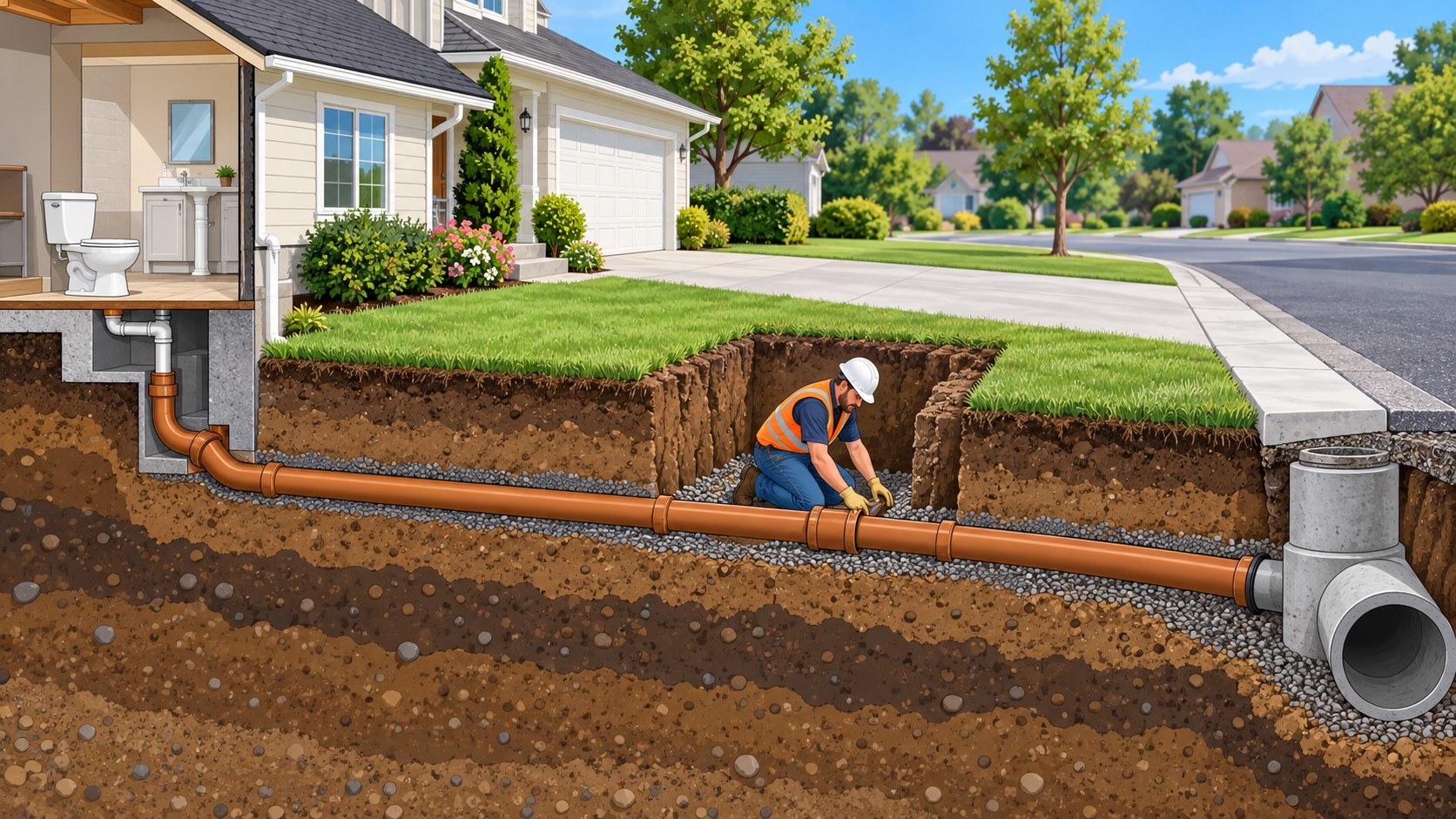
“Sewer line” can mean different parts of the drainage system. This article covers the private building sewer (also called a sewer lateral or side sewer) that carries wastewater from your home toward the public sewer.
Don’t assume your property line is where your responsibility ends. Local rules differ. Seattle Public Utilities, for example, says a property owner’s side sewer extends all the way to the public sewer main, and New York City also makes property owners responsible for their sewer service line up to the city main. Other cities split responsibility differently.
Before you authorize expensive work near a sidewalk, street, easement, or public connection, ask your local sewer utility where private responsibility ends and whether special permits or approved contractors are required.
What Drives the Price of Sewer Line Replacement?
1. How Much Pipe Actually Needs Replacing
Replacing 15 feet of failed pipe is a very different project from replacing 70 feet from the house to the connection point. This is why a camera inspection matters. If the failure is limited to one section, a spot repair may be possible. If the pipe has widespread deterioration, repeated offsets, major root intrusion, or several failed sections, a longer repair or full replacement may make more sense.
2. The Depth and Location of the Pipe
A shallow line under open lawn is easier to reach than a deep line near a foundation or under a driveway, patio, retaining wall, or mature landscaping. Deeper digging takes more labor, equipment, safety measures, and backfill. Access for machinery matters too. A tight side yard can make the same job much slower.
3. What Has to Be Dug Up and Put Back
The pipe itself is only part of the bill. Traditional replacement means exposing the line, installing new pipe, backfilling, and restoring the surface. Lawn restoration may be fairly simple. Concrete, pavers, a driveway, walkways, or decorative landscaping can make restoration a major cost. Angi puts yard and driveway restoration at roughly $1 to $25 per square foot.
Ask whether restoration is included in the sewer contractor’s price or handled by someone else. Two bids can look thousands of dollars apart simply because one includes restoration and the other doesn’t.
4. Open-Trench vs. Trenchless Replacement
Traditional open-cut replacement exposes the pipe by digging a trench. Trenchless methods reduce surface disruption, but “trenchless” doesn’t mean no digging, and it doesn’t automatically mean cheaper.
- Pipe bursting pulls a new pipe through the path of the old one, breaking the old pipe apart as it goes. It needs access pits at each end.
- Cured-in-place pipe (CIPP) lining places a resin-soaked liner inside the existing pipe and cures it to form a new pipe within the old one.
| Method | Typical Cost | Best Suited For |
|---|---|---|
| Traditional open trench | Within the $50 – $250/ft range, plus restoration | Collapsed or badly misaligned pipe; shallow lines under open lawn |
| Pipe bursting | $60 – $200 per linear foot | Replacing a failing line along the same path with less digging |
| Pipe lining (CIPP) | $90 – $250 per linear foot | Structurally suitable pipe with cracks, leaks, or root entry; lines under driveways or slabs |
Method costs from HomeGuide national data.

The right method depends on the pipe’s condition and alignment, access, local requirements, and the specific defect. Collapsed or badly sagging sections may need excavation or a spot repair before a trenchless method will work. The key question isn’t “Can you do this trenchless?” It’s “Why is this method right for my pipe?”
5. The Type and Extent of the Damage
Sewer lines fail for different reasons: root intrusion, separated joints, corrosion, cracks, sagging (“bellied”) sections, crushed pipe, or full collapse. Different failures call for different fixes. A recurring clog doesn’t automatically mean the whole line must be replaced. On the other hand, repeatedly clearing a line with a serious structural defect may only postpone a bigger repair. Ask the contractor to show you the evidence, ideally on camera video, and explain which defects need repair.
6. Pipe Material, Labor, Permits, and Site Conditions
On many sewer jobs, the pipe itself isn’t the biggest expense. Labor, excavation, equipment, disposal, permits, inspections, and restoration often outweigh it. Soil type, groundwater, nearby utilities, weather, contractor availability, and local rules all play a role. HomeGuide puts permits at roughly $30 to $500, but requirements vary by city.
Don’t Approve an Underground Project Blind
Our free Before You Hire Home Repair Cost Checklist helps you compare estimates side by side, spot missing items like restoration and permits, and know what to ask before you sign.
Related Sewer Costs to Know
Not every sewer problem ends in a full replacement. These national ranges can help you understand the smaller jobs you may see on an estimate:
| Service | Typical Cost |
|---|---|
| Sewer camera inspection | $100 – $500 |
| Snaking / clearing a main line clog | $150 – $600 |
| Hydro jetting | $250 – $800 |
| Root removal | $100 – $600 |
| Spot repair of a cracked section | $600 – $1,050 |
| Sewer permit | $30 – $500 |
Sources: HomeGuide and Angi national cost data. Local prices vary.
Why a Sewer Camera Inspection Is Worth It
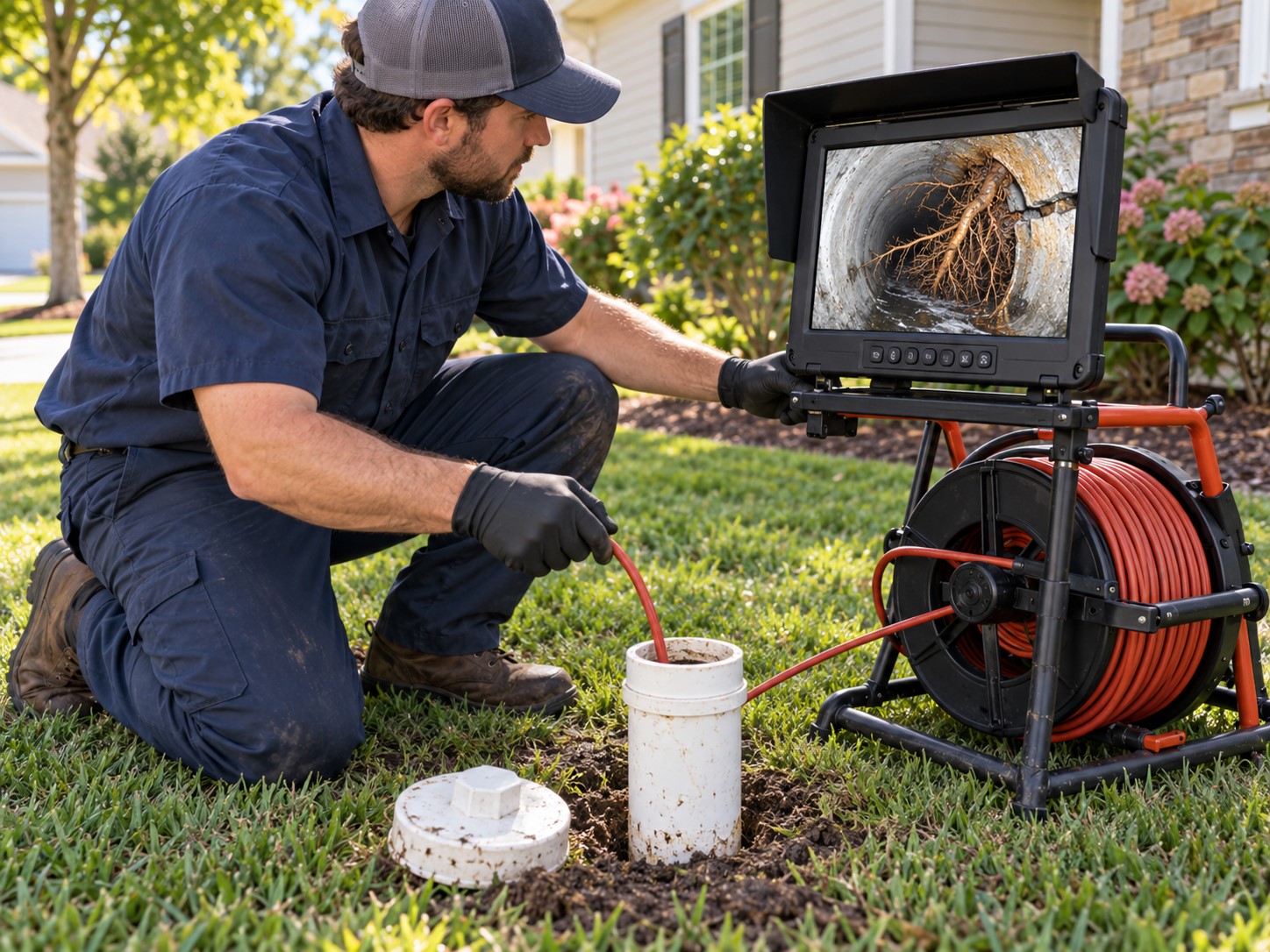
A sewer camera lets a qualified professional look inside the line and document roots, breaks, offsets, deterioration, and some kinds of collapse. Seattle Public Utilities specifically recommends hiring a plumber or sewer inspector who can run a video camera through the line when evaluating problems.
A camera doesn’t answer every question. The line may be blocked, submerged, or collapsed, and the camera can’t see the surrounding soil. But it gives you far better information than approving a major replacement just because a drain backed up. If replacement is recommended, ask the contractor to show you the problem on the video and point out roughly where it is.
How Long Do Sewer Lines Last?
Pipe material and age matter. According to HomeGuide, older clay and Orangeburg (a tar-paper-based pipe used in some mid-20th-century homes) typically last about 30 to 60 years, while PVC, cast iron, and copper sewer lines can last 50 to 100 years. If your home is older and still has its original sewer line, it’s worth asking what material it is and what condition the camera shows.
Repair, Line, or Replace?
Depending on the condition of the line, possible approaches include clearing a blockage, a spot repair, replacing one damaged section, lining a structurally suitable pipe, pipe bursting, or replacing the line by open excavation. There may be more than one reasonable option. Seattle Public Utilities notes that contractors may recommend different repair methods based on the sewer’s condition and their experience, which is one reason getting several written bids helps on a large project.
When the proposed work is expensive, ask each contractor to explain why their method is better than the alternatives for your particular line.
Does Homeowners Insurance Cover Sewer Line Replacement?
Often, no. Standard homeowners policies typically don’t cover sewer line damage caused by wear and tear, age, or tree roots, and Angi notes that a clogged sewer line usually isn’t covered. Some coverage options may help, though:
- Service line coverage is an optional add-on some insurers offer for buried utility lines, including sewer laterals.
- Sewer backup coverage is a separate add-on that may help with damage inside your home from a backup. It usually doesn’t pay to repair the pipe itself.
- Some cities and utilities offer service line protection programs for a monthly fee.
Check your policy or call your insurance agent before work begins, and ask exactly what is and isn’t covered.
How to Compare Sewer Line Replacement Estimates
A useful sewer estimate tells you exactly what’s being replaced and what happens before and after the new pipe goes in. Before choosing a contractor, ask:
- What did the camera inspection or evaluation show?
- How many feet of pipe will you repair or replace?
- Where does the work start and end?
- What method are you recommending, and why?
- What pipe material and size will be installed?
- Are excavation, backfill, hauling, permits, and inspections included?
- What lawn, landscaping, concrete, driveway, or interior restoration is included?
- What could change the price after digging starts, and how will you handle it?
- Will there be a final inspection or a post-work camera scope?
- What workmanship and material warranties apply?
The goal isn’t to pick the company with the longest proposal. It’s to understand what each price includes so you’re comparing the same work.
What Can Change the Price After Work Begins?
Underground work always carries some uncertainty. The pipe may be deeper than records show, more deteriorated than the camera revealed, or blocked by a collapse, and other utilities can complicate access. That doesn’t make an open-ended estimate acceptable. Ask how unforeseen conditions are handled, which changes need your approval, and whether the bid lists unit prices for likely extras such as additional footage or concrete restoration. Written expectations matter because most of the work disappears underground once the trench is closed.
If Sewage Is Backing Up Into Your Home
Treat an active backup as more than a pricing question. The U.S. Environmental Protection Agency warns
that sewage can contain harmful pathogens, so avoid contact with it. Contact a qualified plumbing or sewer professional, and
if the problem may involve the public sewer, follow your local utility’s reporting instructions.
Sewer Line Replacement Cost: Frequently Asked Questions
Is trenchless sewer replacement cheaper?
Not always. Trenchless methods can cost as much or more per foot than open-trench work, but they may save money on restoration when the line runs under a driveway, patio, or mature landscaping. Compare total project cost, including restoration, not just the per-foot price.
How long does sewer line replacement take?
Many trenchless jobs are completed in a day or two. Open-trench replacement often takes several days, plus time for inspections and restoration. Longer or deeper runs, permits, and weather can extend the timeline.
Who is responsible for the sewer line between my house and the street?
It depends on where you live. In some cities the homeowner is responsible all the way to the public main, even under the street. Check with your local sewer utility before work begins.
How much does a sewer camera inspection cost?
Typically about $100 to $500, depending on your area and whether the line needs to be cleared first. It’s often a worthwhile step before approving a major repair.
Can a sewer line be repaired instead of replaced?
Often, yes. If damage is limited to one section, a spot repair or lining may be possible. Widespread deterioration, collapse, or serious sagging may make replacement the better long-term choice.
The Bottom Line on Sewer Line Replacement Cost
For planning, roughly $50 to $250 per linear foot is a useful current national range, and a 40-foot replacement may land around $2,000 to $10,000. But the number that matters for your home depends on the failed section, depth, access, method, permits, and everything that must be dug up and restored to reach the pipe.
Before approving a major sewer replacement, make sure you understand three things: what’s wrong with the line, why the proposed method fits that problem, and exactly what the price includes. Those answers make it much easier to compare estimates instead of judging an underground project by one number alone.
Get the Free Before You Hire Checklist
Download our free Before You Hire Home Repair Cost Checklist. Use it to compare sewer quotes, catch missing line items, and ask the right questions before you commit thousands of dollars.
Sources
- HomeGuide: How Much Does Sewer Line Replacement Cost?
- Angi: How Much Does Sewer Line Replacement Cost? (2026 Data)
- Seattle Public Utilities: Side Sewer Repair Methods
- Seattle Public Utilities: Side Sewer Maintenance
- NYC Department of Environmental Protection: Service Line Protection Program
- U.S. EPA: Sanitary Sewer Overflows (SSOs)
House Care
Compass provides general educational information to help homeowners better understand repair and replacement decisions.
Cost figures are national planning estimates and will vary by location, home, and contractor. For advice about your
specific home or project, consult an appropriately qualified professional.
Roof Replacement Cost: What Homeowners Should Expect to Pay

Last updated: September 2026
A new roof is one of the biggest checks most homeowners will ever write, and the price can feel like a mystery until the estimates arrive. This guide explains what a roof replacement typically costs, what drives the price up or down, which hidden costs to plan for, and what to ask before you hire a contractor.
Quick Answer: How Much Does a Roof Replacement Cost?
- The national average is about $9,600, and most asphalt shingle roofs land between $6,000 and $20,000 (Angi, 2026 data).
- Installed prices usually run about $4 to $11 per square foot for common materials. Premium tile and slate can cost more.
- Biggest cost drivers: roof size and steepness, material, how many old layers must be removed, hidden decking damage, and local labor rates.
- Set aside 10% to 15% extra for surprises found during tear-off.
- These are national planning figures. Your home’s actual price can be different, so compare at least three written, itemized estimates.
How Much Does a Roof Replacement Cost?
According to Angi’s 2026 cost data, the national average roof replacement costs about $9,600. Across all materials and home sizes, prices range from roughly $5,900 to $46,000. For the most common choice, asphalt shingles, most homeowners pay somewhere between $6,000 and $20,000.
Contractors usually price roofs by the roofing square, which is a 100-square-foot section of roof. For a standard architectural asphalt shingle roof, a planning figure of about $4 to $8 per square foot (or $400 to $800 per square), including materials and installation, is a reasonable place to start.
Asphalt Shingle Roof Cost by Roof Size
Roof size is the biggest single driver of cost. Here is what a standard asphalt shingle replacement may cost at $4 to $8 per square foot:
| Roof Area | Estimated Cost (Asphalt) | Typical Home |
|---|---|---|
| 1,000 sq. ft. | $4,000 – $8,000 | Small ranch, bungalow, or townhome |
| 1,500 sq. ft. | $6,000 – $12,000 | Modest single-story home |
| 2,000 sq. ft. | $8,000 – $16,000 | Typical family home |
| 2,500 sq. ft. | $10,000 – $20,000 | Larger or two-story home |
| 3,000 sq. ft. | $12,000 – $24,000 | Large or multi-level home |
Note: Your roof area is usually larger than your home’s living space. Roof slope, overhangs, and an attached garage all add square footage. A steep roof can have 30% to 50% more surface area than the footprint of the house beneath it.
What a Standard Roof Replacement Quote Usually Includes
- Tear-off and disposal of the old roofing (usually one layer)
- Underlayment and ice-and-water shield in leak-prone areas
- New shingles, starter strips, and ridge caps
- New flashing around chimneys, valleys, walls, and vents
- Labor, cleanup, and the building permit (confirm the permit is included)
How Roofing Materials Affect Your Total Cost
Roof size decides how much material you need. The type of material is the biggest wild card in your budget. It also helps to look at cost per year of life. A material that costs more upfront can work out cheaper over time if it lasts much longer.
| Material | Installed Cost per Sq. Ft. | Typical Lifespan | Rough Cost per Year of Life (per Sq. Ft.) | Things to Watch For |
|---|---|---|---|---|
| Asphalt Shingles | $4 – $8 | 15 – 30 years | $0.13 – $0.53 | Shorter lifespan; vulnerable to high wind and algae staining |
| Wood Shakes | $6 – $15 | 20 – 40 years | $0.15 – $0.75 | Regular maintenance; rot and insect risk; fire rules in some areas |
| Metal | $7 – $16 | 40 – 70 years | $0.10 – $0.40 | Can be louder in rain or hail without good underlayment; fastener quality matters |
| Clay / Concrete Tile | $10 – $20 | 50 – 100 years | $0.10 – $0.40 | Very heavy; framing must be confirmed to carry the load |
| Natural Slate | $10 – $30+ | 75 – 150+ years | $0.07 – $0.40 | Very heavy and brittle; needs specialized installers |
Cost-per-year figures are rough planning comparisons made by dividing installed cost by lifespan. Actual lifespan depends on climate, installation quality, ventilation, and maintenance.
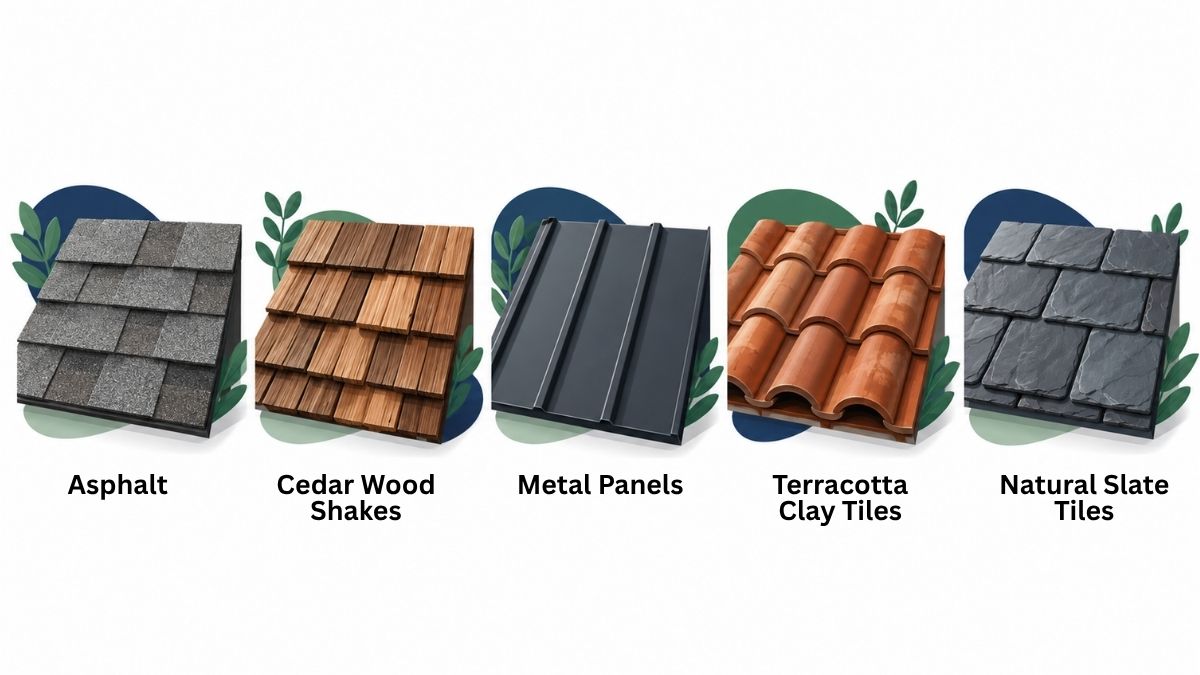
A Closer Look at Each Material
1. Asphalt Shingles: The Budget-Friendly Standard
Asphalt shingles are the most common roofing material on U.S. homes.
- The good: Lowest upfront cost, widely available, and many color options.
- The trade-off: Shortest lifespan of the common materials, and more exposed to storm and UV damage.
- What to ask: If your budget allows, ask for architectural (laminated) shingles instead of basic 3-tab shingles. They usually cost a little more but offer better wind resistance and longer warranties.
2. Metal Roofing: The Long-Lasting Alternative
Metal roofs range from lower-cost exposed-fastener panels to premium standing-seam systems.
- The good: Long lifespan, strong fire resistance, and sheds snow well. Reflective finishes may help reduce cooling costs in hot, sunny climates.
- The trade-off: Higher upfront cost than asphalt, and experienced metal installers can be harder to find in some areas.
- What to ask: Ask what underlayment and fasteners the contractor plans to use. Both affect noise and long-term leak resistance.
3. Wood Shakes: Natural, Rustic Look
Usually cedar, wood shakes have a distinctive look that weathers from warm brown to silver-gray.
- The good: Natural beauty and some added insulation value.
- The trade-off: Higher maintenance. Wood needs regular care to limit rot, moss, and mildew.
- What to check: Review your local building codes and talk with your homeowners insurance company first. Some areas restrict wood roofing because of fire risk, and some insurers charge more for it.
4. Clay and Concrete Tile: Built for Warm Climates
Common on Spanish, Mission, and Mediterranean-style homes, tile holds up well to heat and coastal air.
- The good: Resists rot and insects, highly fire-resistant, and can last for generations.
- The trade-off: Tile is very heavy, often much heavier than the framing of a typical shingle-roofed home was designed to carry.
- What to check: Before switching to tile, have a qualified structural engineer confirm your framing can support it. Also note that while tiles can last decades, the underlayment beneath them often needs replacing sooner.
5. Natural Slate: The Premium Long-Term Option
Slate is quarried stone split into thin tiles and is one of the longest-lasting roofing materials available.
- The good: Extremely durable, fireproof, and can last well over a century when properly maintained.
- The trade-off: One of the most expensive options, very heavy, and brittle. A careless step can crack a tile.
- What to ask: Only hire contractors with specific, verifiable slate experience.
Other Major Factors That Change Your Estimate
Size and material set the foundation of your price, but several other factors can move the final number.
1. Roof Pitch and Complexity
- Steep roofs cost more. Roofs that are too steep to walk comfortably (often around a 6:12 pitch or steeper) need extra safety equipment and slower work.
- More features, more labor. Valleys, hips, dormers, chimneys, and skylights all need custom cuts and flashing, which adds labor hours.
2. Number of Existing Shingle Layers
- One layer: Standard, and usually built into the base price.
- Two layers: If a previous owner roofed over the original shingles, both layers must come off. That means more labor and higher disposal fees.
3. Property Access
- Easy access: A single-story home with a driveway near the roofline lets the crew work efficiently.
- Limited access: Multiple stories, tight lot lines, delicate landscaping, or trees can force crews to carry materials by hand, adding time and cost.
4. Where You Live
- Local labor rates, permit fees, and building code requirements vary widely by region.
- Timing matters too. After major storms, roofers in the area are in high demand, and prices and wait times can rise.
Hidden Roof Replacement Costs to Plan For
A roof replacement is partly a demolition project. Once the old roofing comes off, crews often find problems that could not be seen from the ground. These are the most common add-on costs.
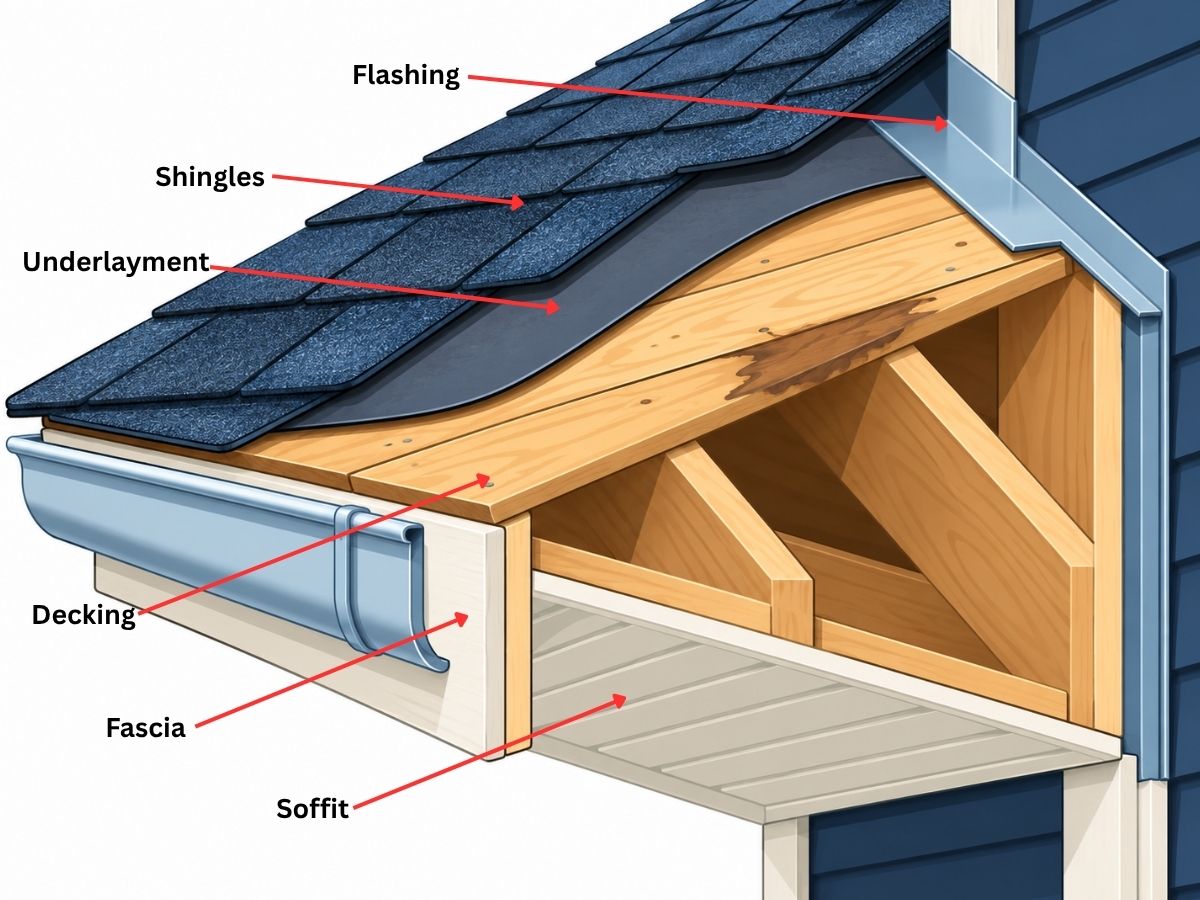
1. Damaged Roof Decking (Sheathing)
Your shingles are nailed to wood panels, usually plywood or OSB, called decking or sheathing. If your roof has leaked, some of that wood may be soft or rotted, and new shingles cannot be properly fastened to it. Because this damage is usually hidden until tear-off, plan for a possible charge of roughly $70 to $120 per 4×8 sheet replaced. Ask each contractor to put their per-sheet price in writing.
2. Rotted Fascia and Soffit Boards
The fascia (the trim board your gutters attach to) and soffit (the underside of the roof overhang) can rot when gutters overflow or ice dams form. Replacing damaged sections can add $500 to $2,000 or more, depending on how much needs replacing.
3. Attic Ventilation Upgrades
Poor attic ventilation traps heat and moisture, which can shorten shingle life and may affect your shingle warranty. If your current ventilation does not meet the manufacturer’s requirements or local code, adding ridge or soffit vents typically adds about $300 to $1,500.
4. Chimney Crickets and Masonry Repairs
- Chimney cricket: Under the International Residential Code, which many areas use, chimneys wider than 30 inches generally need a cricket (a small peaked structure behind the chimney that steers water around it). Adding one often costs $300 to $800.
- Mortar repair: If the chimney’s mortar is crumbling, a mason may need to repair it before new flashing can seal properly.
5. Skylight Replacement
Skylight flashing is disturbed during tear-off anyway, so a roof replacement is often the most cost-effective time to replace older skylights. Plan on roughly $800 to $1,800 per unit when done alongside the roof.
6. Solar Panels and Satellite Dishes
- Solar panels must be removed and reinstalled by a solar company, which often costs $1,500 to $3,500 or more depending on system size.
- Satellite dishes can be removed by roofers, but you may need your provider to reinstall and re-aim it.
7. Permits and HOA Approval
- Permits: Most areas require one. Angi’s data puts roofing permits anywhere from $100 to $1,400, with many falling in the lower part of that range.
- HOA approval: If you have a homeowners association, you may need approval for your material and color before work starts.
Pro Tip: Use the 10% to 15% Contingency Rule
Because no one knows exactly what is under your old shingles until they come off, set aside an extra 10% to 15% of your estimate for surprises. If the crew finds solid decking and healthy trim, that money stays in your pocket. If they do find damage, you can approve repairs without scrambling.
Don’t Get Blindsided by Your Roofing Estimate
Our free Before You Hire Home Repair Cost Checklist walks you through the questions to ask, the line items to look for, and the red flags to avoid, so you can compare quotes with confidence.
Check Your Attic Before You Get Estimates
Your attic can offer early clues about your roof’s condition, and knowing what you’ve seen helps you ask better questions when contractors visit. Only look if you can do so safely: use good lighting, stay on the framing or a walkway, and never step between joists onto insulation or drywall.
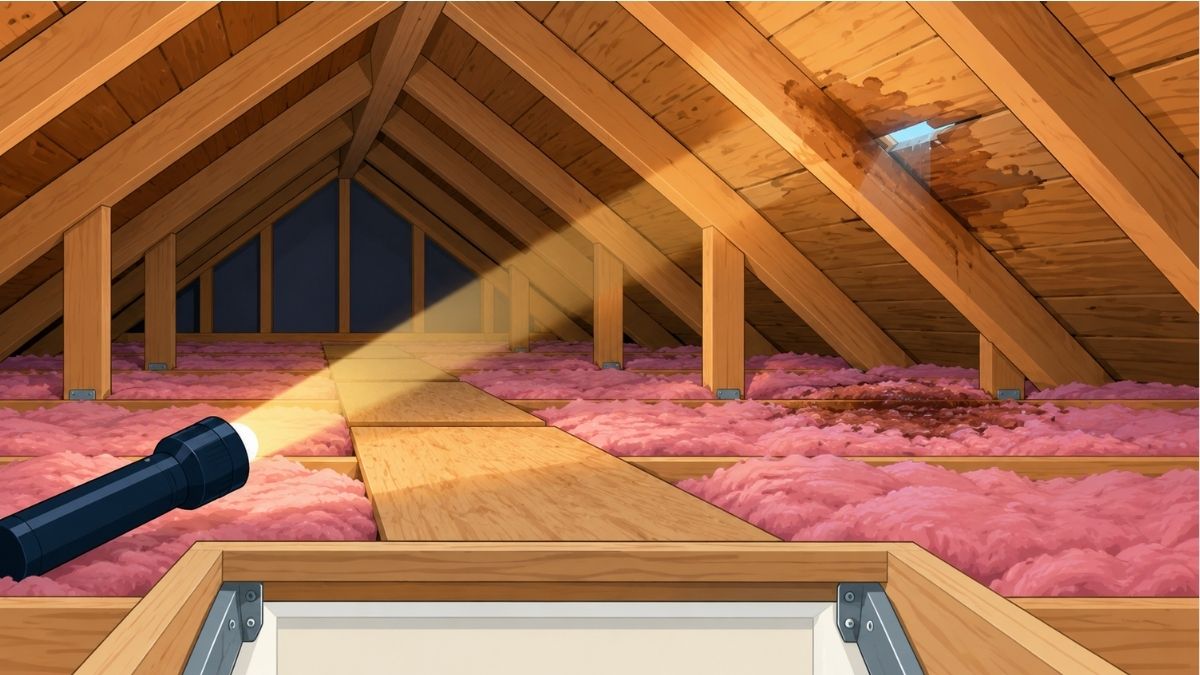
Things worth noting:
- Daylight showing through the roof boards
- Water stains, dark spots, or damp insulation
- Sagging between rafters or areas of decking that look warped
- Mold or a musty smell, which can point to moisture or ventilation problems
- Frost or heavy condensation on the underside of the roof deck in cold weather
These signs are clues, not a diagnosis. Share what you see with a qualified roofing professional who can inspect the roof directly and tell you whether a repair or a replacement makes sense.
Roof Repair vs. Roof Replacement: How to Decide
Before committing to a full replacement, it is worth asking whether a targeted repair would do the job. The right answer depends on a few key factors.
1. The Age of Your Roof
A 5- to 10-year-old asphalt roof with a small leak is usually a good repair candidate. A roof that is 20 to 25 years old or more is near the end of a typical asphalt lifespan, so repairs may only buy a little time before more problems appear.
2. How Much of the Roof Is Damaged
A common rule of thumb among roofers: if damage covers less than about 30% of the roof, a repair is often practical. When damage spreads across a larger share of the roof, repair costs can start to approach the cost of a replacement.
3. Active Leaks vs. Cosmetic Wear
- Cosmetic wear, such as algae staining, minor curling, or a few missing shingles, is often an easy, low-cost fix.
- A single leak from one failed spot, like a cracked vent boot, can usually be repaired.
- Multiple leaks in different areas can signal that the roof system as a whole is wearing out.
4. Your Long-Term Plans
If you plan to sell soon, a professional repair may be enough to get through a home inspection. A new roof can also help at resale: according to the 2025 Cost vs. Value Report, an asphalt shingle roof replacement recouped roughly two-thirds of its cost in added home value on average. If you plan to stay for many years, replacing an aging roof now may save you from repeated repair bills.
Quick Checklist: Repair or Replace?
A repair may make sense if:
- Damage is limited to one small area, such as where a branch fell.
- Only a few shingles are missing after a storm.
- The roof is less than about 15 years old and has been well maintained.
- A repair can safely buy you a few years to save for a replacement.
A replacement may make more sense if:
- The roof is near or past its expected lifespan.
- You see widespread sagging or soft spots.
- You are paying for repairs year after year.
- Shingles are curling, cracking, or losing granules across most of the roof.
- Your insurance company has flagged the roof’s age or condition.
Paying for a New Roof
Few homeowners have $10,000 or more set aside for a roof, so it helps to know the common ways people pay for one:
- Homeowners insurance: May cover damage from sudden events like hail, wind, or a fallen tree, minus your deductible. It typically does not cover a roof that simply wore out with age. Check whether your policy pays replacement cost or actual cash value.
- Contractor financing: Convenient, but read the terms closely. Some “no interest” promotions charge deferred interest if the balance isn’t paid off in time.
- Home equity or personal loans: Home equity options usually have lower rates but use your home as collateral. Personal loans are faster but often cost more in interest.
Whatever you choose, compare the total cost of borrowing, not just the monthly payment.
How to Get Accurate Estimates and Hire the Right Contractor
Even the best materials will fail early if they are installed poorly. These steps help protect your investment.

1. Get at Least Three Written Estimates
- Get at least three detailed quotes from local, licensed, and insured roofers.
- Compare apples to apples. Make sure each quote covers the same materials, shingle grade, and scope of work.
2. Verify Credentials
- License: If your state or city licenses roofers, ask for the number and verify it with the licensing agency.
- General liability insurance: Ask for a current certificate of insurance.
- Workers’ compensation: Confirm coverage so you are not exposed if a worker is injured on your property.
- A local presence: Be cautious of out-of-town “storm chasers” who appear after major storms and may be hard to reach later for warranty work.
3. Ask for an Itemized, Written Bid
A solid estimate should clearly list:
- The brand and product line of the shingles or other materials
- The type of underlayment
- Whether the old roof will be fully torn off
- Disposal and dumpster costs
- The price per sheet for any rotted decking replacement
- Ventilation work, if needed
- The payment schedule and warranty terms
4. Understand the Payment Schedule
Reputable contractors do not ask for the full price upfront. Deposit amounts vary, and some states legally limit them. California, for example, generally caps home improvement deposits at 10% of the contract price or $1,000, whichever is less. Check your state’s rules, and plan to pay the final balance only after the work is complete, the site is cleaned up, and any required final inspection has passed.
5. Know Your Two Warranties
- Manufacturer’s warranty: Covers defects in the roofing materials.
- Workmanship warranty: Provided by the contractor and covers installation errors. Terms vary widely, so get the length and coverage in writing.
- Contractors certified by a shingle manufacturer (such as GAF or Owens Corning programs) may be able to offer extended warranties that cover both materials and labor.
6. Watch for Red Flags
- A bid far below the others may mean cut corners or costs that will be added later.
- High-pressure tactics, like “today-only” pricing or pushing you to sign over an insurance check before work begins.
- Cash-only payment requests, which leave you without a paper trail.
Roof Replacement Cost: Frequently Asked Questions
How long does a roof replacement take?
Many asphalt shingle roofs on typical homes are replaced in one to three days. Larger homes, steep or complex roofs, premium materials, weather delays, or hidden damage can extend the timeline.
Can I put new shingles over my old roof?
Sometimes, but it is often not recommended. Many building codes do not allow a new layer if the roof already has two layers, if the existing roof is damaged or water-soaked, or with certain materials like tile or slate. Roofing over also hides the decking, so rot can go unnoticed. Check local code and ask your contractor.
Does homeowners insurance pay for a new roof?
Insurance may help when damage comes from a sudden, covered event such as hail, wind, or a fallen tree. It usually does not pay to replace a roof that has worn out from age. Review your policy and talk with your insurer about your specific situation.
Do I need a permit to replace my roof?
In most areas, yes. A licensed contractor typically pulls the permit and includes the fee in the quote. Confirm this in writing before work begins.
What is the cheapest time to replace a roof?
Roofers are often busiest in late summer and fall and right after major storms. Scheduling during a slower season in your area, when weather allows, may give you more flexibility on timing and price.
Your Next Step
A roof replacement is a big decision, but you don’t have to walk into it blind. Before you call a contractor, get a rough sense of your roof’s size, decide which materials fit your budget, and know which questions to ask so you can compare every estimate side by side.
Get the Free Before You Hire Checklist
Download our free Before You Hire Home Repair Cost Checklist. It helps you compare roofing quotes, spot missing line items, and avoid common costly mistakes before you sign anything.
House Care Compass provides general educational information to help homeowners better understand repair and replacement decisions. Cost figures are national planning estimates and will vary by location, home, and contractor. For advice about your specific home or project, consult an appropriately qualified professional.
AC Replacement Cost: What a New Central AC System May Cost in 2026
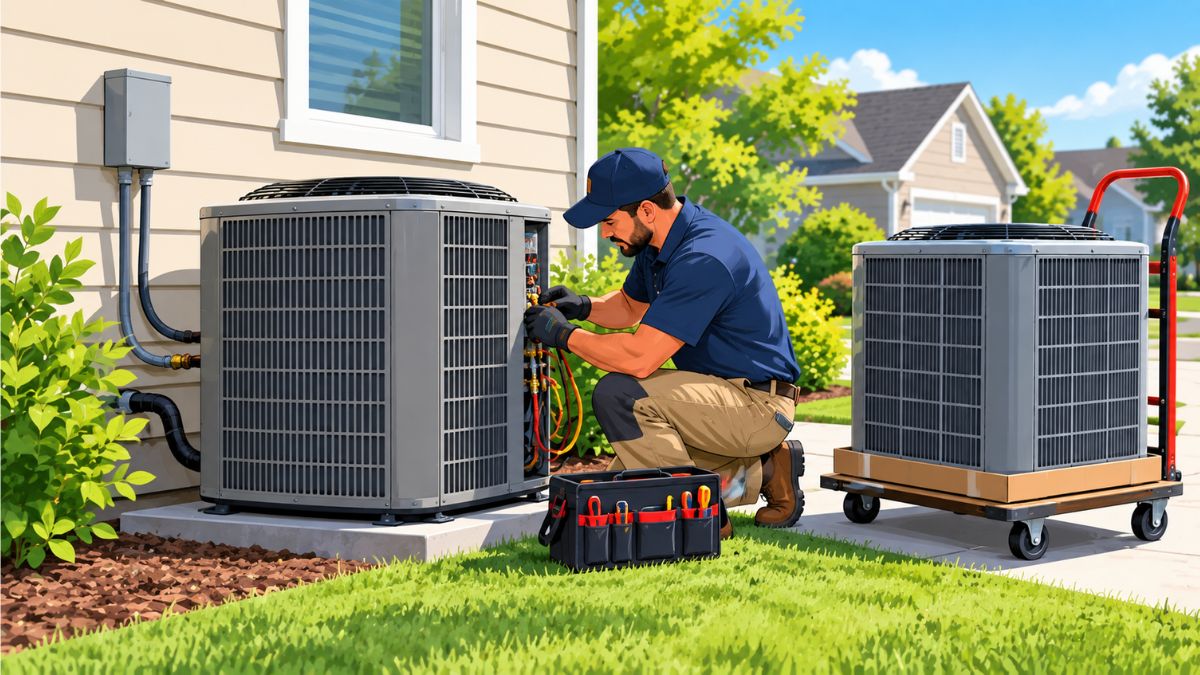
Last updated: September 2026
If your central air conditioner is failing, one of the first questions is usually also the biggest: How much is this going to cost? This guide walks through current planning ranges, what drives the price, why two quotes can be thousands of dollars apart, and what to ask before you sign.
Quick Answer: How Much Does AC Replacement Cost?
- Many standard-to-midrange central AC replacements fall around $5,000 to $12,500 installed.
- High-end systems and complicated projects can reach $14,000 to $15,000 or more.
- Biggest cost drivers: system size and efficiency, which indoor and outdoor parts are replaced, ductwork or electrical changes, installation difficulty, and local labor rates.
- Heads-up for 2026: the federal 25C tax credit for AC and heat pump upgrades ended after 2025, but local utility rebates may still be available.
- These are national planning figures. Your home’s price can differ, so compare written, itemized estimates for the same scope of work.
What Does an AC Replacement Usually Cost?
Current national estimates show why homeowners run into very different numbers. HomeGuide places a standard-efficiency AC replacement at about $5,000 to $8,300 installed, a mid-range system at about $8,300 to $12,500, and high-end systems at roughly $12,500 to $14,000 or more. Carrier gives a broader 2026 installed range of about $3,000 to $15,000 or more, depending on unit size, efficiency, the home, and installation complexity.
| Efficiency Tier | Typical Installed Cost | What You Usually Get |
|---|---|---|
| Standard | $5,000 – $8,300 | Single-stage cooling that meets current minimum efficiency |
| Mid-range | $8,300 – $12,500 | Higher SEER2, often two-stage cooling and better humidity control |
| High-end | $12,500 – $14,000+ | Variable-speed operation, top efficiency, quieter, advanced controls |
Source: HomeGuide national cost data. Ranges assume a straightforward replacement; ductwork, electrical, or access issues can add to the total.
AC Replacement Cost by Size (Tonnage)
Residential AC capacity is measured in tons. One ton equals 12,000 BTUs per hour of cooling. Larger systems cost more. Here are HomeGuide’s installed ranges for standard-efficiency central AC units by size:
| System Size | Estimated Installed Cost (Standard Efficiency) |
|---|---|
| 2 tons | $5,000 – $6,800 |
| 2.5 tons | $5,400 – $7,200 |
| 3 tons | $5,800 – $7,800 |
| 3.5 tons | $6,200 – $8,300 |
| 4 tons | $6,500 – $8,800 |
| 5 tons | $7,000 – $9,500+ |
Higher-efficiency equipment at any size will cost more. The right size for your home should come from a load calculation (see below), not from this table.
Make Sure You’re Comparing the Same Thing
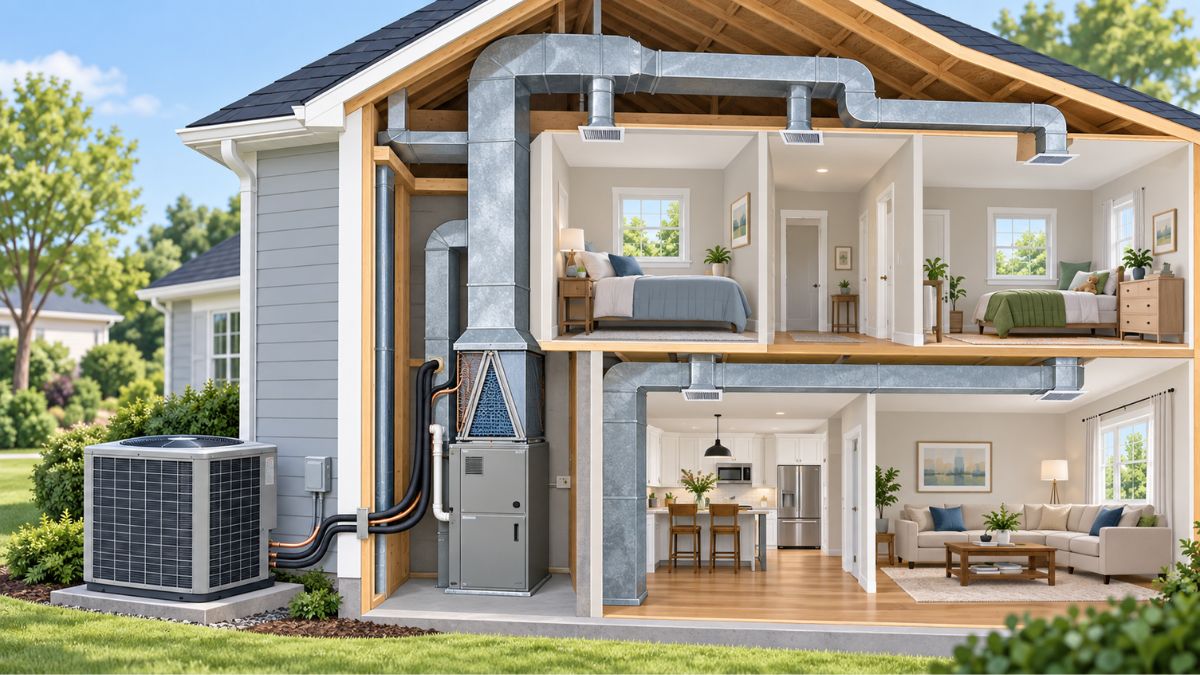
“AC replacement” doesn’t always mean the same job. One estimate may cover mainly the outdoor unit. Another may include a matched outdoor condenser and indoor evaporator coil. A broader HVAC estimate could add an air handler or furnace, thermostat, ductwork, electrical work, and other changes. When someone tells you a new AC “should cost” a certain amount, ask what that number actually includes.
The Biggest Factors That Affect AC Replacement Cost
1. The Size of the System Your House Actually Needs
Larger-capacity air conditioners cost more, but choosing the right size matters more than buying the biggest unit your budget allows. Equipment should be sized to your home’s cooling needs, not square footage alone. The Air Conditioning Contractors of America (ACCA) describes Manual J as the ANSI-recognized standard for calculating residential heating and cooling loads. It accounts for insulation, windows, air leakage, orientation, and other features of your home.
That gives you an important question to ask: “How did you determine the size of the system you’re recommending?” If your old unit was 4 tons, that doesn’t automatically mean the new one should be. New windows, added insulation, air sealing, or an addition can change what your home needs.
2. Efficiency Level (SEER2)
Air conditioners are now rated with SEER2, the current seasonal efficiency metric. Minimum efficiency requirements differ by region. The North, Southeast, and Southwest have different standards for central air conditioners.
Higher-efficiency equipment usually costs more upfront. Premium systems may add two-stage or variable-speed operation, better humidity control, quieter operation, and communicating controls. Higher efficiency isn’t automatically the best financial choice for every home, so ask the contractor to show you:
- the SEER2 rating of each option,
- the price difference between options, and
- which equipment or features account for that difference.
3. Which Equipment Is Actually Being Replaced
A central AC system has parts both inside and outside your home. An estimate might include the outdoor condenser, indoor evaporator coil, air handler or compatible furnace components, refrigerant lines, drain components, thermostat, and installation materials. Another estimate may include fewer of those items.
That makes the scope of work as important as the bottom-line price. A $7,000 bid isn’t necessarily a better deal than a $10,000 bid until you confirm both contractors are replacing the same components and doing the same supporting work.
4. Existing Ductwork
If your ducts are in reasonable shape and compatible with the new system, they may not need major changes. If a contractor finds damaged, undersized, disconnected, or badly leaking ducts, the project can get much more expensive. According to Angi, installing new ductwork can cost roughly $3,000 to $7,500.
Not every older duct system needs replacing. Ask what problem the contractor found, where it is, and whether they’re recommending a minor repair, a modification, or a full replacement.
5. Electrical and Installation Changes
A replacement isn’t always as simple as swapping one box for another. The job may involve a new electrical disconnect, breaker, or wiring; an equipment pad; condensate drainage; new refrigerant lines; and permits. Access matters too. Equipment in a hot, cramped attic or tight closet takes more labor than equipment that’s easy to reach. These items should appear on the estimate, not show up as surprises after work begins.
6. Refrigerant and Equipment Generation
If you’re replacing an older AC, the new equipment may use a different refrigerant than your current system. Federal rules restrict higher-global-warming-potential refrigerants (such as R-410A) in newly manufactured residential AC systems, and newer equipment is increasingly designed around lower-GWP refrigerants such as R-454B and R-32. In May 2026, the EPA removed the January 1, 2026 installation deadline for qualifying older inventory, so some contractors may still offer R-410A equipment until that supply runs out.
You don’t need to become a refrigerant expert. But it’s reasonable to ask: “What refrigerant does this system use, and does that affect compatibility with my indoor coil or future service?” That’s especially useful if two contractors are quoting different generations of equipment.
Tax Credits and Rebates in 2026
The federal Energy Efficient Home Improvement Credit (Section 25C), which helped many homeowners pay for qualifying central AC and heat pump upgrades, ended for equipment placed in service after December 31, 2025. If you’re replacing your AC in 2026, don’t count on that federal credit.
You may still find savings closer to home. Many utility companies and some state programs offer rebates for high-efficiency equipment. Check your utility’s website or the ENERGY STAR rebate finder, and ask your contractor which rebates the proposed equipment qualifies for. Get that answer in writing before you rely on it.
Compare AC Quotes With Confidence
Our free Before You Hire Home Repair Cost Checklist helps you line up estimates side by side, spot missing line items, and know what to ask before you sign.
Why Two AC Replacement Quotes Can Be Thousands of Dollars Apart

Say you receive one estimate for $7,200 and another for $10,500. That difference alone tells you almost nothing. The higher estimate might include higher-efficiency equipment, a new indoor coil, electrical changes, a thermostat, permit costs, and modifications the lower one leaves out. Or it might simply be more expensive. You can’t know until you compare the proposals line by line.
A useful AC replacement estimate should clearly show:
- Equipment brand, model, and capacity (tons or BTUs)
- The SEER2 efficiency rating
- Which major components are being replaced (outdoor unit, indoor coil, air handler)
- Labor, permits, and disposal of the old equipment
- Any thermostat, ductwork, or electrical work
- Parts and labor warranty terms
The goal isn’t a 20-page engineering report. It’s understanding what you’re paying for. The cheapest estimate can be a good one, and so can the most expensive. If one proposal includes something another doesn’t, ask why.
Should You Replace Only the AC or More of the HVAC System?
If your air conditioner has failed but your furnace still works, you may wonder why a contractor is talking about other indoor equipment. Sometimes there’s a legitimate compatibility reason. In other cases, keeping usable equipment may be possible. For context, HomeGuide puts a combined furnace-and-AC replacement at roughly $10,500 to $18,500.
Rather than assuming either approach is right, ask the contractor to explain each recommendation:
- Does the new outdoor unit require a different indoor coil?
- Is my existing furnace or air handler compatible with the proposed AC?
- Are you recommending this because something has failed, because of efficiency or refrigerant compatibility, or because replacing parts together makes more financial sense?
The answers should help you understand the recommendation, not just increase the size of the quote.
When Does Replacing an Older AC Start to Make Sense?
Most central air conditioners last roughly 10 to 20 years, depending on climate, maintenance, and installation quality. ENERGY STAR suggests considering a professional evaluation and possible replacement when an air conditioner is more than about 10 years old, especially if it also needs frequent repairs, energy bills are rising, or comfort has declined.
That doesn’t mean an 11-year-old AC automatically belongs in the scrap pile. A relatively inexpensive repair on an otherwise dependable system can make sense. A large repair on an aging system with other problems may lead to a different decision. Weigh the repair cost together with:
- the system’s age and general condition,
- its recent repair history,
- comfort problems such as uneven cooling or high humidity,
- efficiency and energy bills,
- refrigerant and replacement-part availability, and
- the cost and scope of the replacement being proposed.
Questions to Ask Before Accepting an AC Replacement Estimate
You don’t need to know how to install an air conditioner to ask useful questions. Before signing, consider asking:
- What exactly is being replaced?
- What is the model and capacity of the proposed equipment?
- How was the system size determined? Did you do a load calculation?
- What is the SEER2 efficiency rating?
- Does this price include the indoor coil or air handler?
- Does my ductwork need repairs or modifications? If so, why?
- Are electrical changes required?
- What refrigerant does the new system use?
- Are permits and removal of the old equipment included?
- What parts and labor warranties apply, and do I need to register the equipment?
- Does this equipment qualify for any utility or state rebates?
- What could cause the final price to change after work begins?
Those questions reveal far more than asking a contractor to simply “beat” another company’s price.
AC Replacement Cost: Frequently Asked Questions
How long does it take to replace a central air conditioner?
A straightforward like-for-like replacement is often completed in about a day. Projects that involve new ductwork, electrical upgrades, a new indoor coil or air handler, or difficult access can take longer.
Can I replace just the outdoor unit?
Sometimes, but it isn’t always recommended. The outdoor unit and indoor coil are designed to work as a matched system, and a mismatch can hurt efficiency, performance, and warranty coverage. Refrigerant differences between older and newer equipment can also affect compatibility. Ask your contractor to explain why a partial or full replacement makes sense for your system.
What size AC do I need for my house?
There’s no reliable square-footage shortcut. The right size depends on your home’s insulation, windows, layout, air leakage, and climate. A qualified contractor should determine it with a load calculation such as ACCA Manual J.
Is there a federal tax credit for a new AC in 2026?
The federal 25C credit ended for equipment placed in service after December 31, 2025. Utility and state rebates may still be available in your area, so check with your utility and ask your contractor.
Do I need a permit to replace my air conditioner?
Many cities and counties require a mechanical and/or electrical permit for AC replacement. A licensed contractor typically pulls it. Confirm in writing that the permit is included in your quote.
The Bottom Line on AC Replacement Cost
For budgeting, roughly $5,000 to $12,500 is a useful 2026 planning range for many standard-to-midrange central AC replacements. High-end systems may reach about $14,000 or more, and Carrier’s broader installed range extends to $15,000 or more depending on equipment and installation complexity.
But your real decision shouldn’t rest on a national average. What matters is the equipment your home actually needs, what each proposal includes, what extra work is necessary, and how comparable estimates stack up. The best next step is to understand the quote before you sign it.
Get the Free Before You Hire Checklist
Download our free Before You Hire Home Repair Cost Checklist. Use it to compare AC quotes, catch missing line items, and ask the right questions before you commit thousands of dollars.
Sources
- Carrier Residential: Central Air Conditioner Prices (2026)
- HomeGuide: How Much Does AC Replacement Cost?
- Angi: How Much Does AC Replacement Cost? (2026 Data)
- ACCA: Manual J Residential Load Calculation
- AHRI: Residential Central Air Conditioners (SEER2 and regional standards)
- U.S. EPA: Regulatory Actions for Technology Transitions
- ENERGY STAR: Federal Tax Credits for Energy Efficiency
- ENERGY STAR: When Is It Time to Replace?
House Care Compass provides general educational information to help homeowners better understand repair and replacement decisions. Cost figures are national planning estimates and will vary by location, home, and contractor. For advice about your specific home or project, consult an appropriately qualified professional.